
If viewed superficially, war appears as destruction, disorder, and the disruption of normal life. But in the Game, war is structured differently. It does not abolish order — it maintains it. In this sense, war is not chaos, but one of the oldest forms of preserving equilibrium between game zones, poles, and figures.
This is no longer just an abstract balance, as in the previous section. Here we see it in its harshest and most vivid form. War makes mirroring literally visible: each side develops its own center, its own language, its own propaganda, its own army, its own symbols, its own heroes, and its own victims. And yet, each side is forced to organize itself according to the very same logic as the enemy.
The Game does not aim for the complete annihilation of one side. If one side disappears entirely, the tension vanishes, and with it, the structure of the Game itself disappears. Therefore, war does not end with the logic of absolute victory. It continues exactly until the need to maintain balance ceases to exist. No more, no less.
It is precisely in war that the cross-mechanics of the Game are particularly evident. One side strengthens the other through its resistance. One pole creates the conditions for the existence of the other. Victory does not eliminate the opponent permanently, but merely shifts the conflict into a new phase. That is why wars can last for years, decades, and even centuries: not because the participants “cannot come to an agreement”, but because the very system of conflict sustains tension as a condition of its own existence.
Here it is especially important to understand that war is not merely a clash of armies. It is also a means of assigning roles, redistributing resources, fixing borders, renewing power, and determining who holds the center in this Game.
This is precisely why a mirror symmetry almost always emerges in war:
Each side begins to behave as a mirror image of the other. Mirror slogans, mirror symbols, mirror accusations, mirror examples of heroism, and mirror myths of righteousness emerge. War not only destroys, but also creates similarity. Opponents gradually become structurally similar to one another, because otherwise they would be unable to sustain the conflict.
This is no longer just an abstract balance, as in the previous section. Here we see it in its harshest and most vivid form. War makes mirroring literally visible: each side develops its own center, its own language, its own propaganda, its own army, its own symbols, its own heroes, and its own victims. And yet, each side is forced to organize itself according to the very same logic as the enemy.
War does not destroy the mirror; it fixes it in place
The Game does not aim for the complete annihilation of one side. If one side disappears entirely, the tension vanishes, and with it, the structure of the Game itself disappears. Therefore, war does not end with the logic of absolute victory. It continues exactly until the need to maintain balance ceases to exist. No more, no less.
It is precisely in war that the cross-mechanics of the Game are particularly evident. One side strengthens the other through its resistance. One pole creates the conditions for the existence of the other. Victory does not eliminate the opponent permanently, but merely shifts the conflict into a new phase. That is why wars can last for years, decades, and even centuries: not because the participants “cannot come to an agreement”, but because the very system of conflict sustains tension as a condition of its own existence.
War as a Factory of Mirrored Forms
Here it is especially important to understand that war is not merely a clash of armies. It is also a means of assigning roles, redistributing resources, fixing borders, renewing power, and determining who holds the center in this Game.
This is precisely why a mirror symmetry almost always emerges in war:
- army against army;
- headquarters against headquarters;
- propaganda against propaganda;
- sanctions against sanctions;
- alliance against alliance;
- leader against leader.
Each side begins to behave as a mirror image of the other. Mirror slogans, mirror symbols, mirror accusations, mirror examples of heroism, and mirror myths of righteousness emerge. War not only destroys, but also creates similarity. Opponents gradually become structurally similar to one another, because otherwise they would be unable to sustain the conflict.
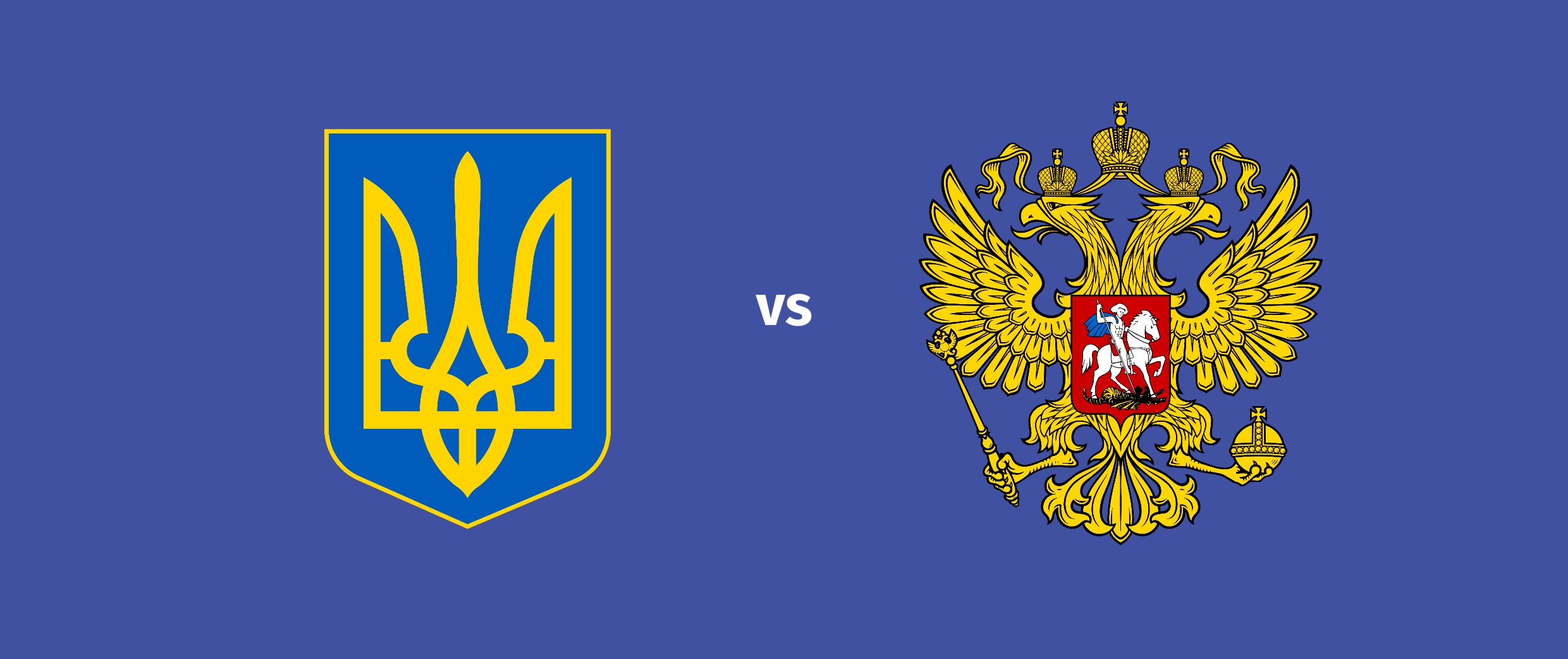
Illustration. The coat of arms of Ukraine represents a classic triad in the form of a trident, embodying the idea of the Trinity, while the coat of arms of Russia combines the duality of a double-headed eagle with a triad in the form of three crowns.
Why the war has lasted so long
History knows of wars that last too long for the usual logic of “win or lose”.
This is not about a random stalemate, but about the fact that the very system of the conflict keeps the parties locked in the battlefield. Every victory turns out not to be the end, but a transition. Every truce is not the end, but a pause between cycles. Every new escalation is not an exception, but a continuation of the same arc.
War here becomes a crude but honest mechanism: it shows that neither side can dominate indefinitely without risking the collapse of the entire structure. And so, the opposition is maintained not out of humanity, but out of necessity.
War as a mechanism for testing the center
War is also a way of testing who holds the center in the Game.
When a conflict begins, it immediately becomes clear:
- who makes the decisions;
- who controls the resources;
- who shapes the image of the enemy;
- who bears responsibility;
- who allocates the sacrifices;
- who transforms chaos into a manageable phase.
- кто превращает хаос в управляемую фазу.
This is precisely why war always lays bare the structure. It makes visible what, in peacetime, may be hidden behind diplomacy, ritual, bureaucracy, or a cultural veneer. War strips the Game down to its mechanics.
Why this is the crudest demonstration of balance
This section serves as the crudest and most obvious demonstration of balance.
There is no need here to explain symbols or numbers at length.
Here, it is enough to see one simple thing:
- The Game is sustained by confrontation, and confrontation is sustained by both sides remaining on the field.
- And as long as the field hasn’t disappeared, the Game continues.
War is not a system failure.
War is its ultimate form of mirroring.
In it, each side exists only because the other exists.