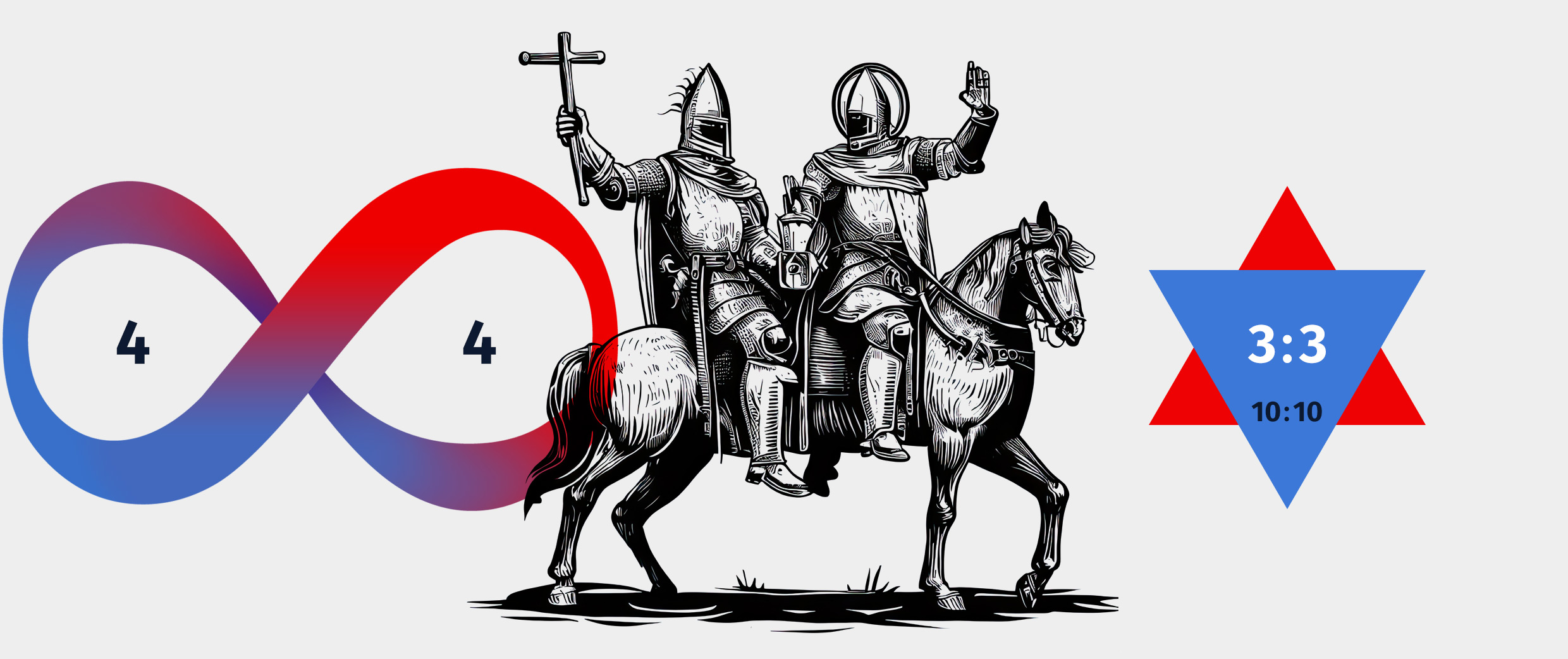



If Mesopotamia became the zero point of the Game — the place where a stable game architecture first took shape — then Ancient Egypt became its first great mirror.
This is not merely a parallel civilization, nor is it a natural “next stage” of development. It is the expansion of the Game: the creation of a new Game Zone through the mirroring and partial inversion of the original model. The Game seizes new territory, modeling the same architecture within it, but dressing it in a different cultural, symbolic, and visual form. Thus is born the appearance of uniqueness and, as a consequence, the foundation for future artificial conflicts.
It is important to clarify right away: other regions were developing at the same time. But it is Mesopotamia and Egypt that set the primary axis upon which all subsequent Game architecture will be built. Egypt does not negate Mesopotamia nor does it replace it. It continues the same mechanics in a different symbolic phase.
In Mesopotamia, the dominant celestial code was the Moon — a symbol of the cycle, of the hidden and the revealed, of the nocturnal aspect of existence. Here, the Moon was not merely a celestial body, but the first stable instrument for interpreting the world’s repetitiveness.
In Egypt, a mirror shift occurs: the Sun (Ra) comes to the fore, becoming the primary symbol of supreme power and visible order. The pharaoh is positioned as the living embodiment of the Sun. The Moon, however, does not disappear but retains its function, though it recedes to a secondary position.
This is not a change in essence, but a mirror-image transformation. The same Game structure uses the opposite pole of the symbolic system to create a new, outwardly distinct Game zone.
The number 12 is a striking example of how the Game preserves fundamental codes while shifting external emphases.
In Mesopotamia, 12 is associated with lunar months. In Egypt, it is transferred to the solar cycle: the day is divided into 12 hours, the night into 12 hours.
This is not merely a parallel civilization, nor is it a natural “next stage” of development. It is the expansion of the Game: the creation of a new Game Zone through the mirroring and partial inversion of the original model. The Game seizes new territory, modeling the same architecture within it, but dressing it in a different cultural, symbolic, and visual form. Thus is born the appearance of uniqueness and, as a consequence, the foundation for future artificial conflicts.
It is important to clarify right away: other regions were developing at the same time. But it is Mesopotamia and Egypt that set the primary axis upon which all subsequent Game architecture will be built. Egypt does not negate Mesopotamia nor does it replace it. It continues the same mechanics in a different symbolic phase.
The inversion of symbols as a game mechanic
In Mesopotamia, the dominant celestial code was the Moon — a symbol of the cycle, of the hidden and the revealed, of the nocturnal aspect of existence. Here, the Moon was not merely a celestial body, but the first stable instrument for interpreting the world’s repetitiveness.
In Egypt, a mirror shift occurs: the Sun (Ra) comes to the fore, becoming the primary symbol of supreme power and visible order. The pharaoh is positioned as the living embodiment of the Sun. The Moon, however, does not disappear but retains its function, though it recedes to a secondary position.
This is not a change in essence, but a mirror-image transformation. The same Game structure uses the opposite pole of the symbolic system to create a new, outwardly distinct Game zone.
The transfer of the number 12 and the preservation of the basic code
The number 12 is a striking example of how the Game preserves fundamental codes while shifting external emphases.
In Mesopotamia, 12 is associated with lunar months. In Egypt, it is transferred to the solar cycle: the day is divided into 12 hours, the night into 12 hours.

Thus, the basic tool for measuring and organizing time remains the same. Only the “clothing” changes — from lunar to solar. This allows the new zone to appear distinctive while still operating within a single, recognizable Game matrix.
Egypt as a Mirror Image of Mesopotamia
Despite obvious external differences — language, writing, art, geography, and the decorative form of authority — the structural architecture remains identical.
In both cases, there is:
- a centralized vertical power structure;
- the sacralization of the ruler;
- the priesthood as the guardian of order;
- accounting, resource allocation, and taxation;
- monumental architecture as a manifestation of hierarchy;
- the division of space into controlled zones;
- duality and the triad as a means of maintaining balance.
Egypt is not a “different” Game. It is the same Game, unfolding in a new territory in a mirrored form. It is not the foundation of power that changes, but its symbolic shell. It is not the mechanism that changes, but its cultural skin.
Such a mechanism is extremely effective:
- it creates the appearance of a unique culture, language, religion, and identity;
- a basis for artificial conflicts and rivalry between zones emerges;
- while the basic mechanics of the Game — verticality, cycles, inheritance of functions, and balance — remain the same.
Expansion as a Principle of the Game
It is precisely here that we see that the Game does not merely exist — it is expanding. All subsequent development of civilizations is the further branching and multiplication of such mirror zones according to the principle of “one architecture — different settings”. The Game conquers new lands, models its rules within them, creates the illusion of diversity, and continues to expand while maintaining a unified foundation.
Mesopotamia — Egypt. Two mirror zones. Two poles. Two cultural garments of the same design.

This is precisely why Egypt is not merely a second civilization, but the first great mirror. It vividly and clearly demonstrates how the same Game architecture can change its appearance without altering its essence.