Part 5. The Fundamental Symmetry of the Game: Masks, Balance, and Function Inheritance
(Special Expanded Version)
In this chapter, we will also show that God, in the context of the Games, is not a metaphor for faith, but the ultimate form of the One Source.
If everything is born from the one, then all presidents, kings, sheikhs, and rulers are merely different masks of a single essence: they mirror one another and function as a single organism of power, within which balance, inheritance, and the Game unfold.
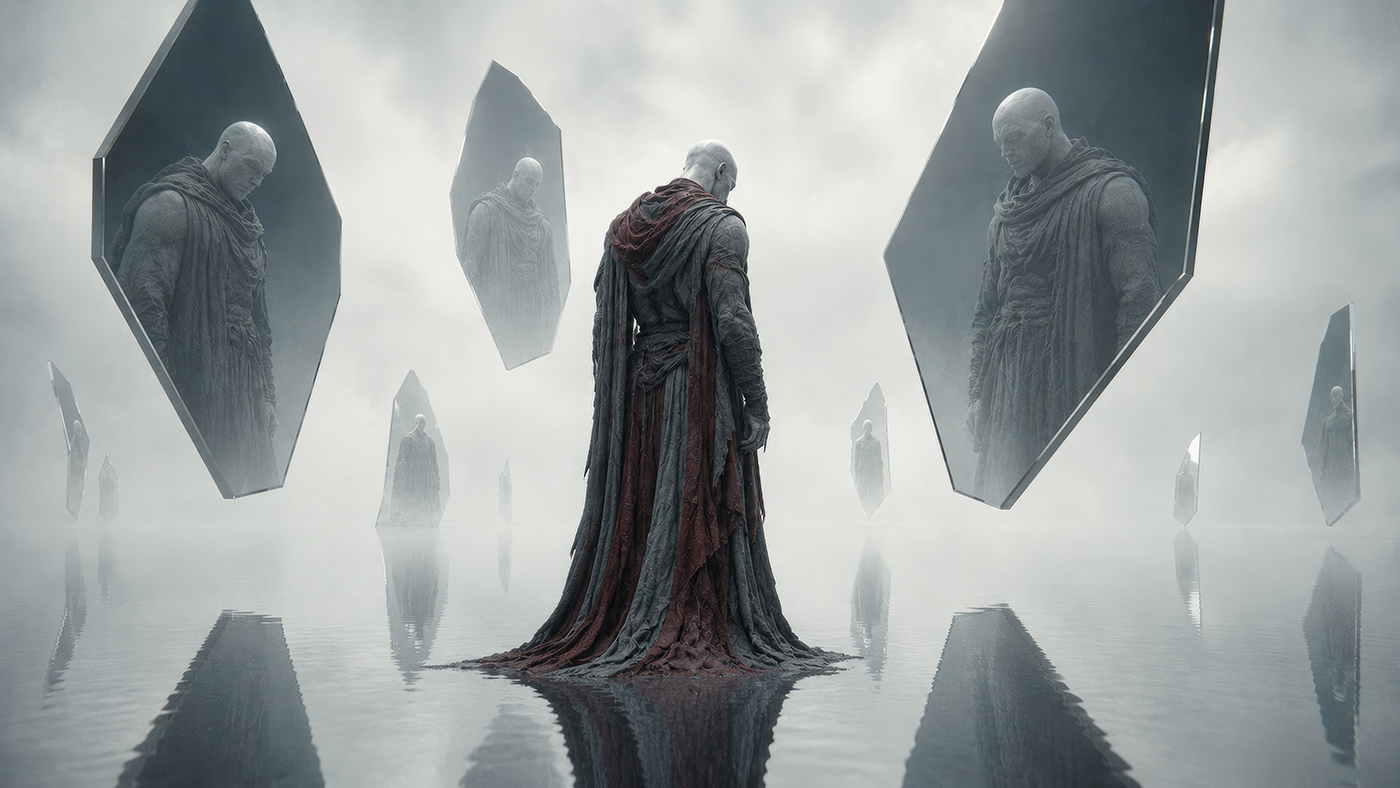
Illustration.
The metaphor of the Architect, Engineer, Creator. The image is based on Prometheus, the Titan.
1. Introductory Box
This chapter requires one simple yet fundamental action from the reader: to view the Game not as a set of separate events, but as a unified structure of reproduction. Externally, it can take on a wide variety of forms — political, economic, cultural, religious, everyday, cinematic. But within it, the same principle operates: mirroring, inheritance, and the distribution of functions.
So let’s establish the main point right away. Mirroring is neither a decorative device nor an artistic metaphor. It is the mechanism by which the Game exists, repeats itself, and preserves itself over time. Through mirrors, the Game is not merely reflected — it is duplicated, transferred, adapted, and established in new forms. This is precisely why we are not speaking here of random coincidences, but of a recurring architecture in which, for example, a number, a name, an image, a date, and a function begin to function as interconnected markers of the same structure.
The same applies to the mask. Here, a mask does not mean a face, makeup, or outward appearance. A mask is a role, a function, and a position within the structure. A person may change, but the mask lives on, passing to another bearer while retaining its form and meaning. This is precisely why we are not talking about biographies in the usual sense, but about the mechanics behind them.
This chapter is not about individual fates. It is about how the Game’s architecture repeats itself through pairs, triads, balance, inheritance, and fragmentation. We will show how key figures at the top of Alpha turn out to be mirrors of one another not by whim, but by the law of the Game itself. Their differences lie in setting, language, cultural environment, and historical context. But their structural position, functional logic, and dependence on the overall system remain the same.
It is especially important to understand one more thing: mirroring works not only in real life but also in cinema. Here, cinema acts as an echo of the Game, as its visual and semantic continuation. In reality, the Player forms mirror images around himself, and in the film, the same patterns are inherited — through characters, conflicts, numerical rhymes, names, visual coincidences, pairs, and inversions. The screen reproduces the same mechanics that life has already unfolded in reality.
Therefore, in this chapter, we immediately clarify the numerical nature of the Game, show why the leaders of countries are in fact mirrors of one another, and establish that the entire Game ecosystem unfolds in a mirrored fashion across the entire field — from historical zones to modern media. This allows us to see how the roles of certain players emerge — players who, at first glance, seem as though they “shouldn’t” exist there. In reality, they are not random: they are stable elements of the overall structure.
We will proceed from the source to the form, from the form to the mechanics, and from the mechanics to recognizing them in real life and in cinema. And the deeper the reader delves into this logic, the clearer it becomes: the Game is the same everywhere, and only its mirrors, carriers, and modes of visualization differ.