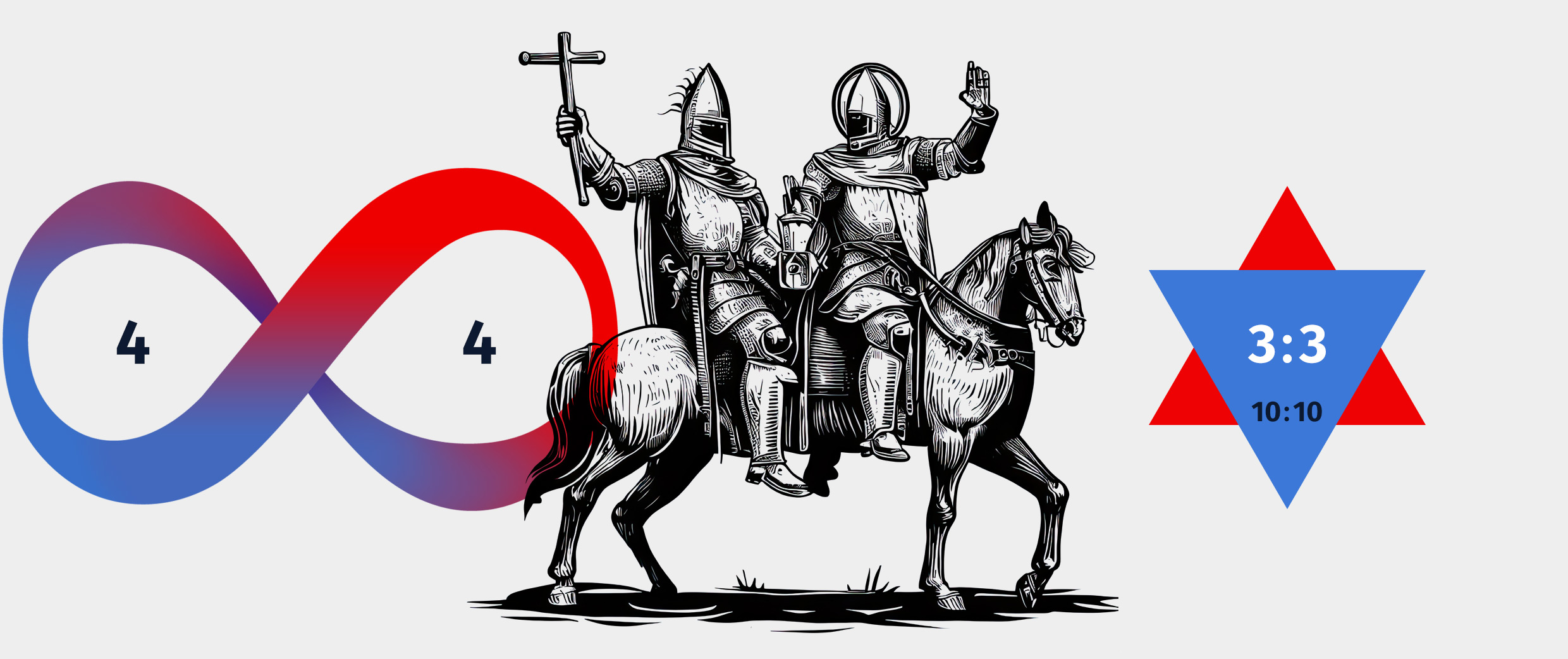



Now that we have shown that the Game architecture arises from a Single Source, splits into pairs, assembles into a triad, and is maintained through balance, the following question arises: how does this structure become visible in real life? The answer is simple: through the mask.

The mask is important here not as a separate symbol or an independent theme, but as clear proof that the Game exists not at the level of abstraction, but at the level of concrete function-bearers. The mask always points to the same thing: there is a role, there is a position, there is a right to act, there is a permissible set of moves. And this role does not belong to the person as such. A person merely wears it temporarily.
This is precisely why the mask is so important for understanding mirroring. If the same role can pass from one bearer to another while the structure itself remains intact, then what we are dealing with is not a random social image, but a stable form of the Game. The person changes, the biography changes, the cultural shell changes, but the logic remains the same. The mask outlives the bearer, which means the Game outlives any specific person.
At this point, the main idea becomes particularly clear: all leaders within the Game are, de facto and de jure, mirrors of a single whole. They can be distinguished by language, religion, appearance, title, ritual, and style, but at a fundamental level, they function as bearers of the same role. The mask of a ruler, the mask of a tsar, the mask of a president, the mask of a pharaoh or a sheikh — these are different historical forms of the same Game position. They differ in appearance but are identical in function.
From this follows a crucial conclusion: the mask does not merely conceal the face; it fixes the structure. It shows that power does not belong to the individual personally, but is embedded in a system where the same function can be reproduced repeatedly under new conditions. Therefore, the mask is not a refutation of mirroring, but its direct confirmation. If the role is repeated, if the bearers change, if the symbolism flows from one zone to another, then a single pattern is at work.
It is precisely here that it becomes clear that the Alpha elite is not a collection of independent figures, but a single organism of mirror-image bearers of a single function. Their differences are secondary. Primary is their belonging to a common architecture. Each top-tier player is not merely “similar” to another — he occupies the exact same structural position within a different cultural shell. This is how the effect of inheritance arises: the mask is passed on, reworked, adapted, but does not disappear.
Therefore, within the framework of this chapter, the mask is needed not for a repeated theoretical explanation, but as a legally and logically significant argument: if functions are inherited, if carriers change, if the form repeats itself, then the Game is structured not as the sum of individual biographies, but as a unified mirror system. And this is precisely what we are proving.
When we speak of world leaders, we must see not “great men”, but functionaries of a single Game system — mirrors that reflect the same architecture in different settings. Their differences are secondary. Their structural identity is primary.