


What follows is neither a selection of “good movies” nor a review of new releases. It is a series of specific examples where the same Game mechanic becomes visible in different cinematic forms. Each film here is not needed for its own sake, but as a test of the same law: how the Game collects masks, pairs, triads, mirrors, inversions, and the transfer of function from one medium to another.
Therefore, we interpret each case not as a plot, but as a structure.
Therefore, we interpret each case not as a plot, but as a structure.
The film “Sirāt” (2025)
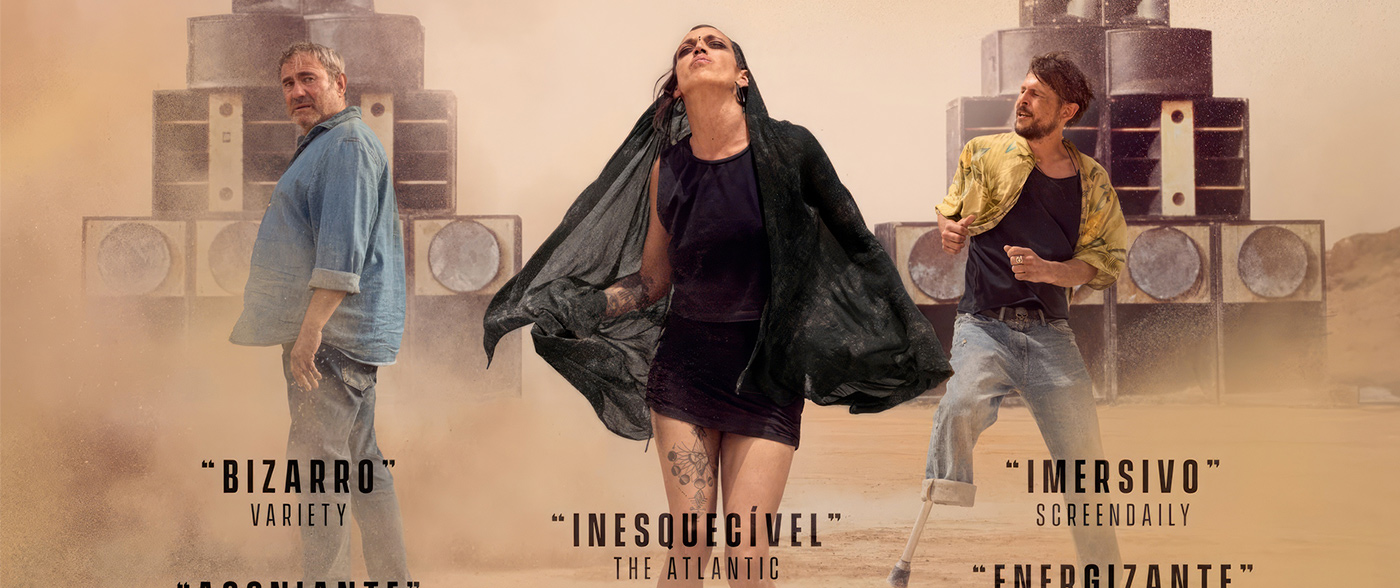
The film “Sirāt” (2025) serves as a vivid illustration of how screen art adopts the rigid mathematical structure of maintaining balance. The film’s inner, semantic layer is literally stretched over the game geometry we have studied, transforming the stated plot into a precise model of hidden confrontation.
From the very beginning of the film, through the visual imagery of dance and rave, the director openly signals the start of the film’s arched structure and establishes the theme of war. This is not merely an artistic choice, but a direct echo of reality: since 2022, the world has faced a series of large-scale, protracted conflicts and catastrophes, the tension of which is keenly felt by each of us. And throughout the film, the characters move through a symbolic hell precisely under this central leitmotif — war unfolding on the playing field. Already in the opening sequence, they cross a river, which serves as a classic marker of entry into the otherworldly, game-like space.
Basic Geometry and Triadic Structure
The director completely rejects the random distribution of elements and subjects the on-screen movement to a strict triadic matrix. The entire convoy consists of three vehicles, each carrying exactly three passengers. There are nine of them in total, three triads.
At the center of this structure, serving as a point of balance, moves a minivan, flanked by two trucks in a classic symbolic arrangement — black and white.
Inside the minivan, the film’s defining triad is established: Luis (Sergi López), his son Esteban (Bruno Núñez Arjona), and their white dog. A direct narrative arc is drawn between father and son (the “beginning” and “end” of the process), where both characters also mirror each other. At the very beginning of the journey, Luis explicitly states that he is looking for his daughter, who loves rave concerts — this line serves as the most crucial trigger, the function of which will only be revealed in the final cut.
Trucks carry their mirror images — fragmented roles that duplicate the functions of the center. The passengers of these vehicles are bound by the law of cross-compensation. Thus, among the members of the flanking groups are the characters Jade Oukid, Stefania Gadda, Tonin Janvier, and Richard Bellamy (“Bigu”). At the same time, the director’s casting choices demonstratively emphasize the system’s checkerboard symmetry: Tonin is missing his left leg, and Richard his right arm. Regardless of how the machines swap places in a checkerboard pattern, these physical markers maintain a cross-assembly: the left compensates for the right, the arm mirrors the leg.
Transfer of function via the domino principle
The interconnection of elements within this structure is demonstrated by specific stage actions operating on the domino principle. One of the characters (“Biguí”) produces a marker of chaos — a contaminated narcotic substance (shit) — and the dog from the central group physically consumes this trace. The impulse created at one end of the system is transmitted and dissipated at the other. Esteban’s character, meanwhile, is always positioned in the middle — between the producer and the consumer — maintaining the point of equilibrium. To the casual viewer, this is a series of everyday mishaps, but at the structural level, it is a clear diagram of the transmission of performative energy.
Reformatting the system in a minefield
After the inevitable death of the boy (Esteban) and his dog, the original structure is not destroyed but is reorganized into rigid paired structures against the backdrop of a metaphorical railroad track, movement along which is likened to a train moving along the rails. The entire system narrows down to three pairs of characters unfolding on the minefield:
The minefield triggers a series of symbolic explosions that dispose of the spent masks according to the law of the mirror boomerang. Jade Oakid is the first to die: her death is presented as a direct response to the aggression she displayed — the impulse returns. Next, Tonin Janvier and Richard Bellamy explode in succession. Each elimination of a physical body merely means that its function instantly shifts to the remaining participants.
The final assembly and the train as a global metaphor
The very title of the game — *Sirāt* — refers to the Eastern concept of a perilous bridge over an abyss, which is sharper than a sword and thinner than a hair. Once you cross this bridge, the game reveals the final outcome. The dog and exactly three characters remain alive: Sergi López, Stefania Gadda, and Joshua Liam Henderson.
In this final build, the features are presented as a complete, polished set. Joshua Liam Henderson’s character definitively claims the mirrored mask of his deceased son. And Stefania Gadda (the woman in red), as an avid raver, perfectly embodies the very daughter Louis spoke of in the film’s prologue. The triad closes, signifying the absolute fulfillment of the original plan.
The film’s final chord — the appearance of a massive train — definitively transports the local drama into the macrocosm of real geopolitics. The carriages of this train carry not random people, but the endlessly multiplying mirror images of the surviving trio. The train becomes the primary military trigger and an associative key to the real large-scale conflicts of our time. It is marked as the deadliest scheme, a monstrous war machine in history.
The journey on this endless train is a metaphor for the global war in which the entire planet is now immersed. The music and dancing at the rave, from which the journey began, turn out to be merely an aesthetic mask for a dirty and deadly game. Humanity is drawn into a single, total scheme of reflections, where every participant is doomed to reproduce the functions of the central characters, and the Game itself inevitably takes on the features of an all-consuming world war.
From the very beginning of the film, through the visual imagery of dance and rave, the director openly signals the start of the film’s arched structure and establishes the theme of war. This is not merely an artistic choice, but a direct echo of reality: since 2022, the world has faced a series of large-scale, protracted conflicts and catastrophes, the tension of which is keenly felt by each of us. And throughout the film, the characters move through a symbolic hell precisely under this central leitmotif — war unfolding on the playing field. Already in the opening sequence, they cross a river, which serves as a classic marker of entry into the otherworldly, game-like space.
Basic Geometry and Triadic Structure
The director completely rejects the random distribution of elements and subjects the on-screen movement to a strict triadic matrix. The entire convoy consists of three vehicles, each carrying exactly three passengers. There are nine of them in total, three triads.
At the center of this structure, serving as a point of balance, moves a minivan, flanked by two trucks in a classic symbolic arrangement — black and white.
Inside the minivan, the film’s defining triad is established: Luis (Sergi López), his son Esteban (Bruno Núñez Arjona), and their white dog. A direct narrative arc is drawn between father and son (the “beginning” and “end” of the process), where both characters also mirror each other. At the very beginning of the journey, Luis explicitly states that he is looking for his daughter, who loves rave concerts — this line serves as the most crucial trigger, the function of which will only be revealed in the final cut.
Trucks carry their mirror images — fragmented roles that duplicate the functions of the center. The passengers of these vehicles are bound by the law of cross-compensation. Thus, among the members of the flanking groups are the characters Jade Oukid, Stefania Gadda, Tonin Janvier, and Richard Bellamy (“Bigu”). At the same time, the director’s casting choices demonstratively emphasize the system’s checkerboard symmetry: Tonin is missing his left leg, and Richard his right arm. Regardless of how the machines swap places in a checkerboard pattern, these physical markers maintain a cross-assembly: the left compensates for the right, the arm mirrors the leg.
Transfer of function via the domino principle
The interconnection of elements within this structure is demonstrated by specific stage actions operating on the domino principle. One of the characters (“Biguí”) produces a marker of chaos — a contaminated narcotic substance (shit) — and the dog from the central group physically consumes this trace. The impulse created at one end of the system is transmitted and dissipated at the other. Esteban’s character, meanwhile, is always positioned in the middle — between the producer and the consumer — maintaining the point of equilibrium. To the casual viewer, this is a series of everyday mishaps, but at the structural level, it is a clear diagram of the transmission of performative energy.
Reformatting the system in a minefield
After the inevitable death of the boy (Esteban) and his dog, the original structure is not destroyed but is reorganized into rigid paired structures against the backdrop of a metaphorical railroad track, movement along which is likened to a train moving along the rails. The entire system narrows down to three pairs of characters unfolding on the minefield:
- First pair: Luis (Sergi López) and Joshua Liam Henderson, who becomes a direct mirror image of Luis’s deceased son.
- Second pair: Stefania Gadda (the woman in red) and Tonin Jeanvier (the character without a left leg).
- Third pair: Jade Oakid and Richard Bellamy (the character without a right arm).
The minefield triggers a series of symbolic explosions that dispose of the spent masks according to the law of the mirror boomerang. Jade Oakid is the first to die: her death is presented as a direct response to the aggression she displayed — the impulse returns. Next, Tonin Janvier and Richard Bellamy explode in succession. Each elimination of a physical body merely means that its function instantly shifts to the remaining participants.
The final assembly and the train as a global metaphor
The very title of the game — *Sirāt* — refers to the Eastern concept of a perilous bridge over an abyss, which is sharper than a sword and thinner than a hair. Once you cross this bridge, the game reveals the final outcome. The dog and exactly three characters remain alive: Sergi López, Stefania Gadda, and Joshua Liam Henderson.
In this final build, the features are presented as a complete, polished set. Joshua Liam Henderson’s character definitively claims the mirrored mask of his deceased son. And Stefania Gadda (the woman in red), as an avid raver, perfectly embodies the very daughter Louis spoke of in the film’s prologue. The triad closes, signifying the absolute fulfillment of the original plan.
The film’s final chord — the appearance of a massive train — definitively transports the local drama into the macrocosm of real geopolitics. The carriages of this train carry not random people, but the endlessly multiplying mirror images of the surviving trio. The train becomes the primary military trigger and an associative key to the real large-scale conflicts of our time. It is marked as the deadliest scheme, a monstrous war machine in history.
The journey on this endless train is a metaphor for the global war in which the entire planet is now immersed. The music and dancing at the rave, from which the journey began, turn out to be merely an aesthetic mask for a dirty and deadly game. Humanity is drawn into a single, total scheme of reflections, where every participant is doomed to reproduce the functions of the central characters, and the Game itself inevitably takes on the features of an all-consuming world war.
The film “Blue Moon” (2025)
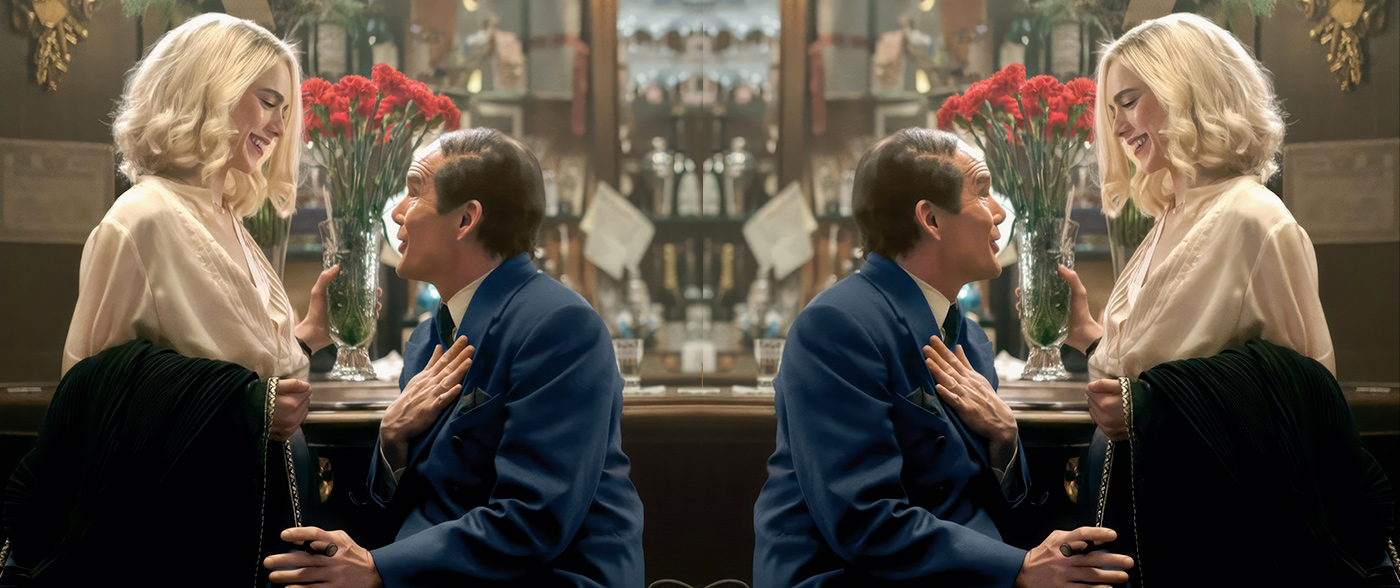
While in the previous example the game’s geometry was discerned through the external arrangement of objects in space, the film “Blue Moon” (2025) demonstrates total mirroring at the level of the characters’ masks. The drama here gives way to a strict chess game, where the characters’ professions — poet, screenwriter, musician, barista — serve not as social characteristics but as functional vessels for conveying their roles within the game. The film artificially constructs a symmetry of forces between the characters, blurring their personal identities in order to maintain balance within the artistic model.
The Governing Triad and Chess Pairs
The film’s masked architecture is based on the principle of multiplicity: each figure embodies at least three levels — a dominant role, an unchanging systemic function, and a reflected component that connects it to the other elements. The director reveals the full scope of this mechanism through the actions of the central triad, formed by Andrew Scott (Richard Rodgers), Ethan Hawke (Lorenz Hart), and Simon Delaney (Oscar Hammerstein II). This trio is the work’s primary structural hub.
Andrew Scott’s character holds the central axis and the position of the mobile center. To make the mirroring of his partners obvious to the audience, Simon Delaney was deliberately cast as Hammerstein — an age palindrome of Hawke (both actors were born in the same year, 1970). Scott interacts with both of them in an identical, mirror-like manner, emphasizing their interchangeability.
This chess-like diagonal is cemented in the frame through a demonstrative scene with a photographer who captures the characters strictly in pairs. The first photograph shows Hammerstein (Delaney) and Rogers (Scott), the second — Rogers (Scott) and Hart (Hawke). Andrew Scott’s character remains the unchanging axis of the frame, while the flanking figures of Hammerstein and Hart mirror each other, confirming that in the Game Space, one mask is capable of duplicating another. Ethan Hawke’s presence is further expanded by the quartet at the bar (Hawke, Cannavale, Kennedy, Lis), where the four characters momentarily merge into a single composite figure, distributing lines and distance among themselves in a perfectly symmetrical mise-en-scène.
The Dynamics of the Mirror Arc: Function Interception
The director implements the principle of mirroring not only through visual duplication but also through plot inversions that run throughout the film, linking the beginning and the end in a tight arc. In the film’s prologue, Ethan Hawke’s character explicitly states that he is organizing a big party and openly hints at an impending romantic relationship with Elizabeth Weiland (Margaret Qualley). However, these events do not actually take place in his space. Instead, in the film’s finale, the viewer sees how Andrew Scott’s character takes over these roles: he goes to “that very party” and it is he who forms a lasting connection with Margaret Qualley’s character.
Through this demonstrative device, the filmmakers vividly illustrate the Law of the Game Arc: the characters at the beginning and end of the journey share a single fate between them, where one declares an intention, and the other takes and realizes the ready-made resource. Margaret Qualley, meanwhile, regularly subverts the basic hierarchy, hinting to Hawk that she is his “mother”, which further complicates the triadic architecture of relationships within this triangle.
The connection between Hart and Elizabeth is deliberately stripped of classic psychological depth and presented as a demonstrative masquerade. The symbolic transition within this pair is marked by color: Elizabeth states that she has dyed her hair, changing the aggressive red-orange shade to a neutral white. In the language of game markers, this signifies a direct shift in the field — a transition from a phase of active confrontation to a phase of purification and the consolidation of the outcome. An additional marker of the underground, hidden nature of Hart’s game is the mouse that runs into his apartment, with which the protagonist directly identifies himself, just as he does with the playing cards he constantly shuffles in his hands, emphasizing that what unfolds before the viewer is not a historical document, but a pre-scripted game.
Numerical References and the Reduction of Catastrophe
The play actively uses spatial and numerical markers to confirm the connection between the characters. The most striking and verifiable example is Lorenz Hart’s address: he lives in an apartment on the 19th floor of a building located on 91st Street. This mirror relationship between the numbers (19 and 91) functions as a trigger, since November 19 is Elizabeth Weyland’s birthday. The character’s spatial coordinates and date of birth are intentionally rhymed, binding the pair into a single structure. The scene with the bouquets at the beginning of the film reinforces this connection: Hart swaps the notes in the flowers, and Elizabeth, arriving later, mirrors his gesture, completing the arc according to the “action — reflection” formula.
The entire narrative fabric of the film is tied to the story of the creation of the famous musical “Oklahoma!”, which Hart leaves on March 31, 1943. The number 31 functions here as an associative trigger for the Game, but the year 1943 itself is far more significant. World War II serves as the backdrop for the characters’ personal drama. As in many other landmark films of the season, the theme of global military conflict is used by the filmmakers as a vast backdrop. The mechanics of the Game operate here through reduction: a colossal global catastrophe is artificially compressed, reduced to the scale of a single artist’s private tragedy. Global chaos is translated into the format of a local theatrical score, helping the system to fix the desired configuration of perception in the mass audience.
The connection to real-world processes and their masks manifests in the film’s prologue, which begins with Hart’s death. The 1937 jazz standard “The Lady Is a Tramp”, playing off-screen, inevitably evokes a strong associative rhyme with the figure of Donald Trump (Trump) in the modern viewer due to the similarity of the words. The political context of the present day shines through the historical setting. Hart declares that his musical will resonate for many years and become a true anthem of America — and this phrase marks the moment when a local artistic container successfully captures and reshapes the real cultural and mental landscape in its own image.
In the finale of the arc, seven months after the triumph of his former mask, Hart collapses on the street and dies. But, as with the principle of the “death of the mirror”, his departure signifies only the disappearance of a specific physical mirror-like medium.
The film “Frankenstein” (2025)

Illustration. A total looking-glass world.
The film “Frankenstein” (2025) is a monumental example of cinema built entirely around a single central character, his mirrors, antitheses, and inversions. The plot here moves not through classical drama, but through the cross-interaction of masks. The main structural conflict manifests through the physical confrontation between the creator (Victor) and the creature he created, whose masks are worn by actors Oscar Isaac and Jacob Elordi. The filmmakers emphasize their direct inversion at the level of birth dates — 1979 and 1997. The mathematical precision of this casting palindrome is visualized in the scene where the monster comes to life, when the movements of both actors in the frame become completely synchronized and mirrored.
The Governing Triad and Cross-Doubling
The film’s internal geometry rests on a delicate balance of forces, where the creator and his creation mirror each other throughout the film, both physically and philosophically. The fact that the monster is merely an external projection of Victor himself is explicitly stated by the filmmakers. On board the ship, Captain Anderson asks the protagonist, “What devil created it?” to which Victor replies directly, “I am the devil”. Victor’s younger brother echoes this very thesis, asserting that the monster is the creator himself.
To maintain the stability of this system, the director constructs a working triad that functions as a single compositional whole: Oscar Isaac (Victor), Christoph Waltz, and Felix Kamerer. Kamerer’s character serves as both a mirror image of Victor and Elizabeth’s fiancé, creating a situation in which Oscar Isaac and the monster effectively “marry” Elizabeth at the same time, confirming the total mirroring of the marital space. Christoph Waltz’s character reinforces and doubles Oscar Isaac’s dominant mask, while Victor’s father closes this vertical axis, forming a cyclical temporal loop where parent and son are indistinguishable.
The Assembly of a Single Body and the Symbolism of the Field
The process of physically constructing the creature elevates the local parable to a macro level, serving as a direct metaphor for global war casualties. Frankenstein is literally assembled from fragments of the bodies of dead people. In the context of the Game, this is a key conceptual node: the monster’s strength and vitality lie in the fact that it consists of a multitude of mirrors of departed players, united into a single collective body. At the same time, the process of its assembly and animation marks the union of heaven and earth, the black and white fields. The antenna used in the scene has exactly five prongs pointing upward and five pointing downward, establishing a fundamental 5:5 game pattern that balances the opposing sides of the board.
The preparation for the act of creation is accompanied by the unveiling of the basic archetypes of human history. Christoph Waltz’s character explicitly states that they are creating “Adam”, while Victor himself constantly carries a miniature construction set figure of a pregnant woman, reinforcing the theme of artificial birth. Mia Goth’s role, through a mirror-like interaction, positions her as a composite maternal matrix — she is simultaneously read as Victor’s mother and the monster’s mother, mirroring Anna’s physical flesh. This is evident in the scene where Valts’s character photographs a nude woman, veiled and biting into a peach — a direct analogue of the biblical apple and original sin.
Recurring motifs and intertextual allusions
The film is woven with a dense network of symbolic markers that connect it to a global context. Mia Goth’s character introduces the theme of the “web” into the plot by displaying books featuring insects, their covers entangled in spiderwebs. Victor expands on this metaphor when he attaches a distinctive metal frame to the future creature’s chest, likening Frankenstein to a spider. This visual device serves as a powerful cross-reference to *Alien* (1979), the *Avatar* film series, and *Iron Man* — a connection that becomes absolutely transparent in the context of modern cinematic incarnations, where Robert Downey Jr. transitions from the role of Iron Man to the mask of Victor von Doom in *Avengers: Doomsday*.
The connection to the Promethean myth is established directly by the authors through a reference to the original subtitle of Mary Shelley’s novel, which builds a strong associative link to the film *Prometheus* (2012) — a prequel to the aforementioned *Alien* (1979). The Russian context and the theme of fixing the final point are manifested through the ship’s crew, striving to return to St. Petersburg, and the very name of the vessel — *Horizon* — signifying the limit of the accessible playing field.
Childlike inversion and numerical reference
A special place in the film’s structure is occupied by the scene in the blind old man’s house, where the childlike, immature nature of Frankenstein’s mask is revealed. Here, a classic narrative inversion is employed: the monster appears as an adult giant but is mentally an infant, while the nearby girl, Anna-Maria, looks like a child but fulfills the role of an adult parent. The very name Anna-Maria conveys duality, referring to sacred female figures (the Virgin Mary and Mary Magdalene) and establishing a generational lineage in which Anna acts as the mother of the Virgin Mary.
The creature’s education proceeds according to the law of pure mirror reflection: Frankenstein stands behind the blind old man, and Anna-Maria stands before him. When the old man pats the girl on the head, the monster precisely repeats this gesture toward himself.
The difference between them is erased in the mechanics of the solar arc, where the born inevitably reflects the parent. Finally, in the process of learning about the world, the monster reads a book and directly identifies himself with Ozymandias — the throne name of Pharaoh Ramses II. The historical date of the beginning of his reign — 1279 — with its numerical code (79) once again brings the attentive reader back to the date of Oscar Isaac’s birth (1979). The narrative circle closes, and the red fiery angel that appears to Victor in the finale serves as a direct visual parallel to the painting “Avatar: Fire and Ashes”, establishing a unified color and thematic framework for the entire cinematic season.
The film “Sentimental Value” (2025)
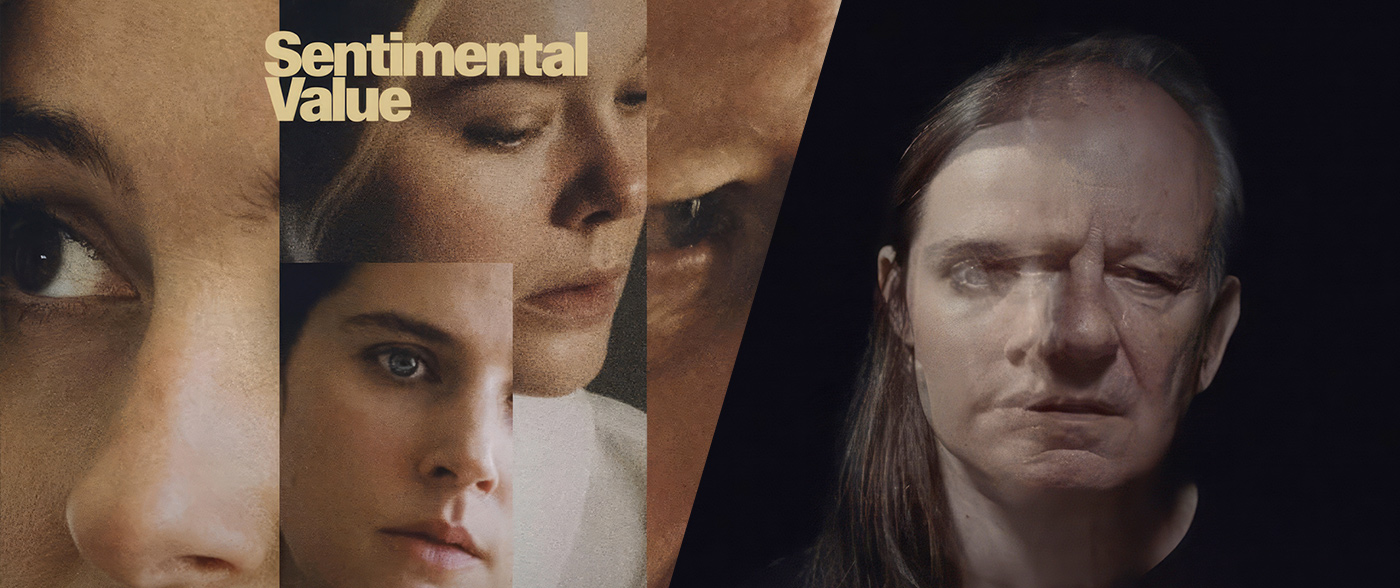
Illustration. The mirror world’s benchmark.
Joachim Trier’s film “Sentimental Value” (2025) is a textbook, almost laboratory-like example of the total decomposition of a single function and its distribution across mirror masks. The director consciously draws on the acting masks from his previous works — primarily from the film “The Worst Person in the World” — to construct a continuous thematic series. The characters here do not belong to autonomous figures but flow from one plane to another, forming a masterfully balanced mirrored multiverse where the characters act as variations, opposites, and reincarnations of one another.
The Triple Mask of “Anna” and Genealogical Inversions
At the center of the film’s architecture is the figure of “Anna” (the name of the hidden role, the mask), whose mask is simultaneously and cross-wise embodied by three actresses: Renate Reinsve, Inga Ibsdottir Lilleas, and Elle Fanning. At the same time, Renate Reinsve plays an actress who is being filmed by her own father, the director (Stellan Skarsgård), in the role of a character named Anna. The first two actresses are sisters in the plot — the daughters of Skarsgård’s character — and function as direct, symmetrical reflections of one another.
This symmetry is rigidly fixed through their paired male counterparts:
- A lover appears in the first sister’s space.
- A husband appears in the second sister’s space.
These male figures mirror each other’s functions while simultaneously serving as direct psychological opposites to the sisters themselves. Moreover, Trier constructs a flawless temporal loop through the figure of the second sister’s young son (played by Inga Ibsdottir Lilleas). As the narrative unfolds, it becomes clear that this boy is a direct mirror image of his grandfather (Stellan Skarsgård). An inversion of age and roles takes place, culminating in the finale: the “film within a film” is shot not by the elderly father at all, but by this very child. The past, present, and future converge at a single point.
The chess-like logic of faces and the merging of masks
The connection between the father and his daughters is resolved by the filmmakers in strict accordance with the laws of chess logic. They are not merely related by blood — they are conceptually identical. The director visualizes this thesis through a demonstrative and verifiable editing technique: for several dozen seconds, the viewer is shown portraits of the father and daughters, whose faces on screen smoothly flow into one another, manifesting the indivisibility of their systemic function. A textual marker reinforces this as well, when the protagonist’s sister directly states that the film’s screenplay looks as though it were written not by their father, but by her herself.
The father’s mask (Skarsgård) simultaneously serves as an integral reflection of the entire male line of the film — he embodies the traits of both the husband and the lover of both sisters. Thus, the director breaks down a single original function into many fragments, distributing them across female and male roles, yet it invariably retains its original geometry.
The House as a Living Organism and Theatrical Leitmotif
The main spatial trigger that pulls this entire multiverse together is the house, where the key events unfold. It functions as an autonomous living organism. Temporal and internal shifts occurring within the system are immediately reflected in its physical state. The most visible marker of the changing playing field is the color of the facade: as the plot unfolds, the house changes its color from vibrant red to neutral white, marking the shift in the Game’s phases and the purification of the structure before the finale.
This spatial shift is reinforced by a pervasive metaphor of the identity of theater, cinema, and reality. The director persistently emphasizes that the surrounding world is structured like a stage, where real people merely reproduce predetermined masks.
The central leitmotif and the main compositional linchpin of this entire complex mirrored architecture is the scene of Anna’s symbolic/metaphorical murder by hanging. It is around this tragic knot, like an axis, that Trier constructs endless enfilades of reflections. The local death of a character within the frame once again serves merely as a tool for disposing of a spent mask, taking the Game to a new level and proving that individual drama is always subordinate to the laws of the overall systemic balance.
The film “Mission: Impossible – The Final Reckoning”

The two-part large-scale project “Mission: Impossible – The Final Reckoning” (including its first part, “Dead Reckoning”) is a direct, representative reflection of the processes taking place on the global playing field. On a superficial level, the film functions as a spy action thriller; however, its internal structure is built on a strict symmetrical balance and a total mirroring of political archetypes. The central axis of the plot is the confrontation between two equally matched figures wearing key masks: Ethan Hunt, played by Tom Cruise, and Gabriel Martinelli, played by Esai Morales. The fact that both actors are the same age (born in 1962) is not a coincidence but a fundamental structural element ensuring their equal dramatic intensity, identical energy, and status as absolute opposites.
Political Mirroring and the “Brotherhood” Marker
Within the narrative framework, the persona of Ethan Hunt functions as a multifaceted political archetype directly linked to the figure of Vladimir Putin (born in 1952), who serves as a recurring associative participant in the global Games. From this perspective, the conflict between Hunt and Gabriel loses the classic Hollywood division into “hero” and “villain”, transforming into a pure model of mutual reflection. This connection manifests itself in the finale, when Gabriel leaves Hunt an audio message that begins and ends with a direct symbolic definition: “Hello, brother”. The word “brother” here marks the identity of leaders and governing masks within a single system.
This thematic thread — the character as a total global subject, simultaneously serving as both the source of the global crisis and its sole solution — is confirmed in the official synopsis of the project “Digger” (2026), starring the same Tom Cruise. The statement that “the most powerful man in the world embarks on a mad mission to save humanity before the catastrophe he has caused destroys everything” definitively deciphers the nature of Cruise’s mask as a direct mirror of supreme state power.
The Russian Node and AI as a Civilizational Entity
The central plot and spatial hub of the duology is the sunken Russian high-tech submarine “Sevastopol”, on board which lies the primary source of the global threat — an autonomous Artificial Intelligence named The Entity. The struggle by all global intelligence agencies to obtain the physical key to this AI underscores that, in the current phase of the Games, state leaders are operating within a single algorithm. The theme of AI as a new, sovereign civilizational entity, acting simultaneously as both judge and executioner of humanity, is systematically echoed in related cinematic projects of the era, tying together a unified narrative.
This narrative framework unfolds sequentially in the film *The Creator* (2023), which depicts humanity’s all-out war against artificial intelligence; the film *Tron: Ares* (2025), which depicts AI’s first physical expansion from the digital realm into the real world, and the thriller “Mercy” (2026), where an advanced algorithm hands down death sentences in a matter of seconds. All these films are not isolated works of art, but function as cross-cutting markers of a unified technological matrix.
Color coding and field inversion
The visual landscape of “The Final Reckoning” is strictly governed by the current color scheme of the Games — a dual combination of red and yellow (gold), also prominently featured in other iconic blockbusters like “Deadpool & Wolverine”. Within the frame, Artificial Intelligence itself is visualized as a flickering golden light enclosed in a sealed glass capsule. At the film’s climax, this color pattern reaches its peak when Ethan Hunt boards a bright yellow plane and flips it upside down in mid-air. This stunt serves as a direct visual metaphor for the inversion of the playing field, vividly demonstrating to the viewer the duality of the world, the reversal of familiar reality, and the system’s transition into a mirrored, inverted state.