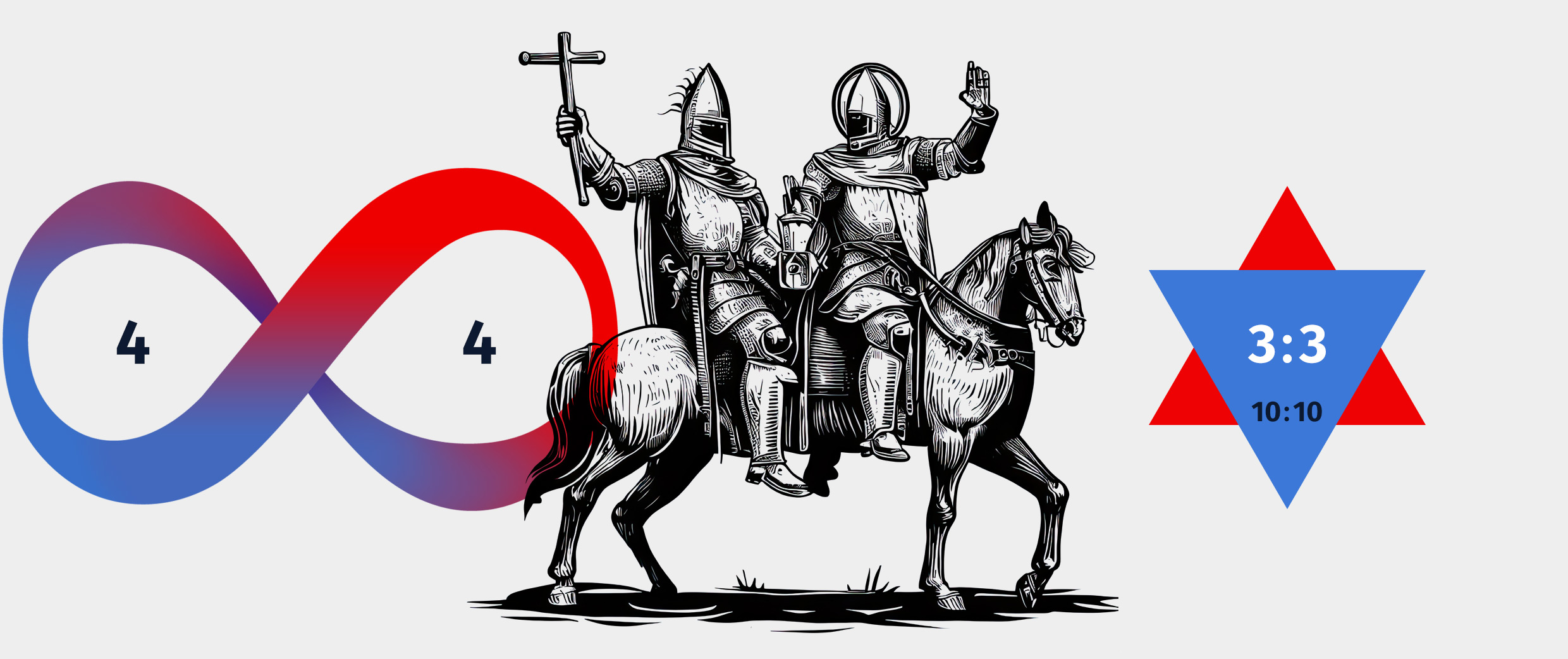



In this chapter, we did not merely describe individual historical forms, but formulated a general law of the Game that applies similarly to the entire film industry.
We have shown that Game reality does not arise from a multitude of independent beginnings. It is built from a single core, which then unfolds into pairs, triads, mirror zones, and fractal copies. This is precisely why different cultures, eras, and institutions appear dissimilar only on the surface. Internally, they are governed by the same structure.
This chapter has unified all films into a single logical system. It clearly demonstrates and explicitly states: characters in any film can reflect real players from anywhere in the world. This interconnection is guaranteed by the fundamental rule of the Game’s mirroring.
Since all the world’s Games are mirror-linked, the cinema of different countries inevitably forms a single meta-ecosystem.
We started from the zero point — Mesopotamia — and then showed its first great mirror — Ancient Egypt. This alone is enough to see that what we have before us is not a random collection of civilizations, but a single axis of the Game, which takes on different cultural forms in different places. The form changes, but not the mechanism. Symbols, language, ritual, and decor change, but not the underlying logic.
All the key elements of the chapter grow from this axis: duality, balance, zenith, arch, triad, inheritance, repetition, and the branching of forms.
We have also shown that masks, figures, and institutions do not recreate the Game. They merely inherit the existing architecture and reproduce it in new bodies, names, symbols, and roles. A person may change, a title may change, the cultural presentation may change, but the function itself remains. The Game continues through a change of vehicles, not through the abolition of the principle.
Hence the main conclusion: the Alpha elite is not an independent stratum standing above the system. On the contrary, it is the most dependent form of the Game itself. The higher the figure, the more deeply it is embedded in the mechanism, because it is precisely through this figure that the system becomes visible, measurable, and controllable. The central figure is no freer than the rest — it merely bears the full weight of the Game and serves as its public face.
This is precisely why leaders, rulers, presidents, sheikhs, kings, and emperors — both de facto and de jure — are reflections of a single organism. Their differences are secondary; their structural identity is primary. They exist not as separate peaks, but as manifestations of the same function, distributed across different regions and eras.
Contemporary examples — cryptocurrencies, artificial intelligence, media, the binary digital environment — only confirm that the same principle applies today.
And then this multitude gathers again into new centers, new masks, and new fractal copies.
It is precisely here that it becomes especially clear: we no longer need to rely solely on statistical data comparison. We have already constructed a coherent mechanical theory where the very logic of the Game explains why mirrors arise, how they are inherited, and by what criteria they are identified. This is not a hypothesis about beautiful coincidences. It is a system that can be understood, reproduced, and applied from scratch.
So, the main point has been proven:
The mechanics are primary.
And it is precisely this that keeps the world in its Game form.
We have shown that Game reality does not arise from a multitude of independent beginnings. It is built from a single core, which then unfolds into pairs, triads, mirror zones, and fractal copies. This is precisely why different cultures, eras, and institutions appear dissimilar only on the surface. Internally, they are governed by the same structure.
This chapter has unified all films into a single logical system. It clearly demonstrates and explicitly states: characters in any film can reflect real players from anywhere in the world. This interconnection is guaranteed by the fundamental rule of the Game’s mirroring.
Since all the world’s Games are mirror-linked, the cinema of different countries inevitably forms a single meta-ecosystem.
We started from the zero point — Mesopotamia — and then showed its first great mirror — Ancient Egypt. This alone is enough to see that what we have before us is not a random collection of civilizations, but a single axis of the Game, which takes on different cultural forms in different places. The form changes, but not the mechanism. Symbols, language, ritual, and decor change, but not the underlying logic.
All the key elements of the chapter grow from this axis: duality, balance, zenith, arch, triad, inheritance, repetition, and the branching of forms.
We have also shown that masks, figures, and institutions do not recreate the Game. They merely inherit the existing architecture and reproduce it in new bodies, names, symbols, and roles. A person may change, a title may change, the cultural presentation may change, but the function itself remains. The Game continues through a change of vehicles, not through the abolition of the principle.
Hence the main conclusion: the Alpha elite is not an independent stratum standing above the system. On the contrary, it is the most dependent form of the Game itself. The higher the figure, the more deeply it is embedded in the mechanism, because it is precisely through this figure that the system becomes visible, measurable, and controllable. The central figure is no freer than the rest — it merely bears the full weight of the Game and serves as its public face.
This is precisely why leaders, rulers, presidents, sheikhs, kings, and emperors — both de facto and de jure — are reflections of a single organism. Their differences are secondary; their structural identity is primary. They exist not as separate peaks, but as manifestations of the same function, distributed across different regions and eras.
Contemporary examples — cryptocurrencies, artificial intelligence, media, the binary digital environment — only confirm that the same principle applies today.
- One gives birth to Two.
- Two are held together by Three.
- Three and its derivatives proliferate into a multitude of forms.
And then this multitude gathers again into new centers, new masks, and new fractal copies.
It is precisely here that it becomes especially clear: we no longer need to rely solely on statistical data comparison. We have already constructed a coherent mechanical theory where the very logic of the Game explains why mirrors arise, how they are inherited, and by what criteria they are identified. This is not a hypothesis about beautiful coincidences. It is a system that can be understood, reproduced, and applied from scratch.
So, the main point has been proven:
- The Game is a unified, reproducible structure in which all forms of power, symbols, roles, and cultural shells are derivatives of a single core.
All differences are secondary.
The mechanics are primary.
And it is precisely this that keeps the world in its Game form.