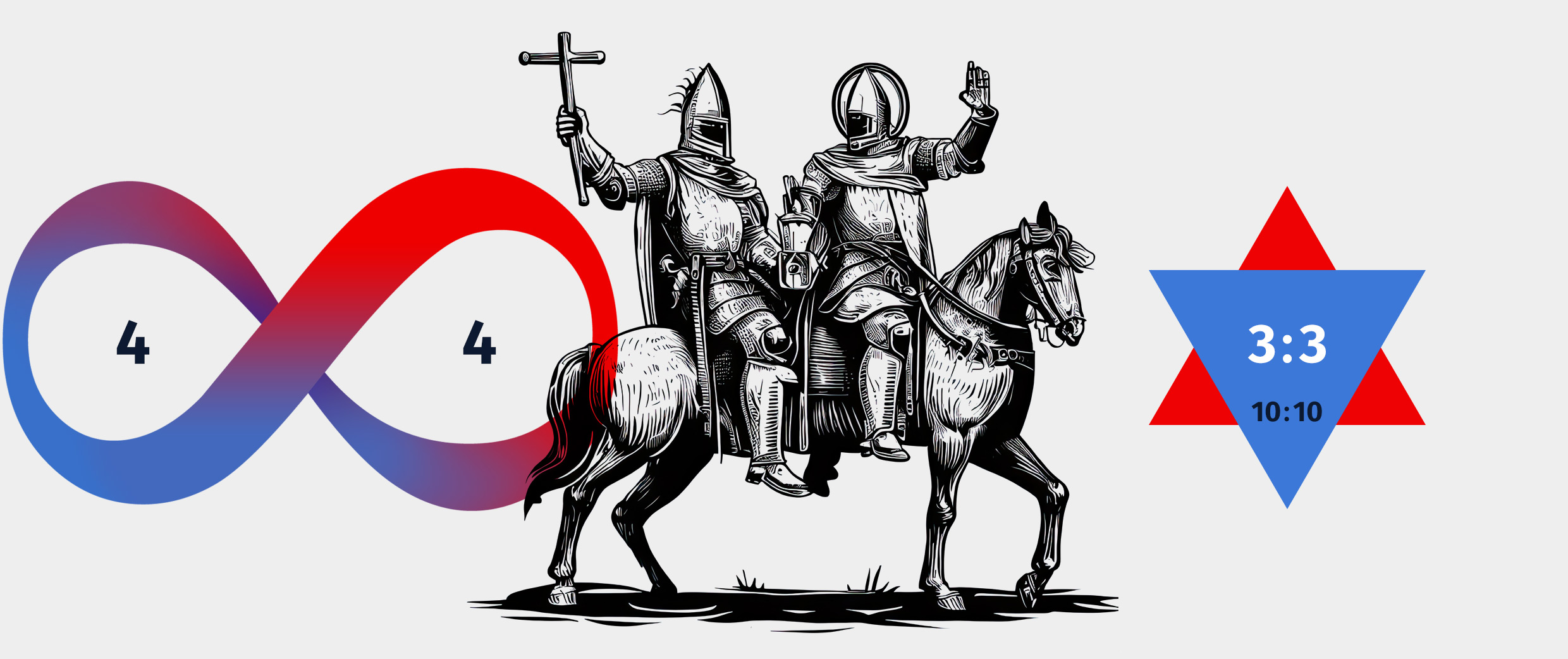



Mirroring does not arise on its own. It is possible only because at the heart of the Game there is always a single source, from which all subsequent forms then unfold. The Game does not begin with two independent sides. It begins with the One — with the original whole, which is not yet divided but already contains within itself the possibility of division.
It is precisely this principle that is particularly evident in the ancient cosmogonies of Egypt and Mesopotamia. They do not merely recount the creation of the world. They capture the very architecture of the Game: how division arises from the One, how a center is born from a pair, and how a multitude of forms emerge from the center.
Heliopolitan cosmogony provides one of the clearest mathematical illustrations of the principle of One → Two → Three → Many.
One: Everything begins with Nun — the primordial, unmanifested ocean of potential. From it arises Atum — the One Creator, the first assembled form, the sacred singularity.
The One gives rise to the Two (scheme 2:2): Atum performs the first division, creating the first pair, which in turn mirrors the second.
This is a classic cross-structure: spiritual twins mirror material forms.
Two give rise to Three (establishment of the Center): Initially, Heaven and Earth are in a merged state — the Game has not yet begun. Shu acts as the active vertical axis and pushes Nut and Geb apart, while Tefnut, together with him, maintains this division as a principle of order and harmony. Thus a stable triad is formed: Heaven — the Axial Center — Earth. The cosmos acquires structure; a space for play emerges.
The Three give rise to the Many: Within the fixed space, Nut and Geb give birth to Osiris, Isis, Set, and Nephthys — the earthly square of polarities. This is already a fractal explosion of forms, masks, cycles, and narratives. The Great Ennead finally closes the perimeter of the Game and gives rise to the entire manifested world.
Thus, Egyptian cosmogony demonstrates flawless game-theoretical mathematics: from the One, through mirror doubling (2:2) and the fixation of the center, an innumerable kaleidoscope of reflections is born, maintaining a connection with the original source.
It is precisely this principle that is particularly evident in the ancient cosmogonies of Egypt and Mesopotamia. They do not merely recount the creation of the world. They capture the very architecture of the Game: how division arises from the One, how a center is born from a pair, and how a multitude of forms emerge from the center.
Egypt: From the One to the Matrix of the Game
Heliopolitan cosmogony provides one of the clearest mathematical illustrations of the principle of One → Two → Three → Many.
One: Everything begins with Nun — the primordial, unmanifested ocean of potential. From it arises Atum — the One Creator, the first assembled form, the sacred singularity.
The One gives rise to the Two (scheme 2:2): Atum performs the first division, creating the first pair, which in turn mirrors the second.
- The first pair is Shu (air, space) and Tefnut (water, moisture).
- The second pair is Nut (Sky) and Geb (Earth).
This is a classic cross-structure: spiritual twins mirror material forms.
Two give rise to Three (establishment of the Center): Initially, Heaven and Earth are in a merged state — the Game has not yet begun. Shu acts as the active vertical axis and pushes Nut and Geb apart, while Tefnut, together with him, maintains this division as a principle of order and harmony. Thus a stable triad is formed: Heaven — the Axial Center — Earth. The cosmos acquires structure; a space for play emerges.
The Three give rise to the Many: Within the fixed space, Nut and Geb give birth to Osiris, Isis, Set, and Nephthys — the earthly square of polarities. This is already a fractal explosion of forms, masks, cycles, and narratives. The Great Ennead finally closes the perimeter of the Game and gives rise to the entire manifested world.
Thus, Egyptian cosmogony demonstrates flawless game-theoretical mathematics: from the One, through mirror doubling (2:2) and the fixation of the center, an innumerable kaleidoscope of reflections is born, maintaining a connection with the original source.

Mesopotamia: The Genetic Triad and Spatial Pairs
The Mesopotamian cosmogonic epic “Enuma Elish” demonstrates the fundamental, primary assembly point of the systemic code. Here, the overarching theme of any game universe — “One → Two → Three → Many” — is translated into the dynamic language of generations. Game characters are invariably born in pairs (dualities), but the very logic of their unfolding is subject to a strict triad that forms the rigid vertical structure of the manifested world.
One: In the beginning, there is the absolute singularity of undivided watery chaos.
“When the sky above was not named, the earth below was not named…” (Enuma Elish, Tablet I)
The system is at the zero point: the elements do not yet have individual names or functional boundaries. The game has not begun.
The Triad of Space (Container)
From the original One, the system crystallizes through three successive steps. Each new generation of deities represents a dual structure, working in pairs and preparing the spatial levels (layers) of the future Game:
- Step 1. The First Pair (Abzu / Tiamat): The division of chaos by qualitative characteristics. Fresh Abzu (the masculine principle, absolute stillness) and Salty Tiamat (the feminine principle, chaotic turmoil). This lays the foundation of the matrix.
- Step 2. The second pair (Lahmu / Lahamu): The first generation of the primordial waters. In the Assyriological tradition, this pair is associated with the emergence of dense, sedimentary matter — river silt and bottom sediments — forming at the interface of aquatic environments. This symbolizes the transition from amorphous chaos to the taking shape, tangible density of the Middle World.
- Step 3. The third pair (Anshar / Kishar): The completion of the primary spatial structuring. These figures define the upper and lower cosmic boundaries — the total Celestial and total Earthly horizons (totality).
Summary of the first triad: Three successive pairs of gods delineate the complete, yet still empty, container of the Game. The system has acquired basic qualities (Step 1), potential density (Step 2), and the extreme spatial boundaries of the Top and Bottom (Step 3).
The Triad of Administrators (Actors) and Mirror Symmetry
As soon as the spatial container is assembled, a triad of active administrators (actors) corresponding to it begins to unfold within it: Anu → Ea → Marduk. At first glance, their genealogical chain is linear, but a detailed architectural analysis reveals a hidden symmetry.
The rulers do not simply succeed one another — they seal and animate the levels of the created Container. The system is assembled using a “shuttle” method, moving from the edges (borders) toward the center:
- Level 1 (top): Container: Anshar/Kishar <=> Actor: Anu (Law of Heaven)
- Level 2 (center): Container: Lahmu/Lahamu <=> Actor: Marduk (Creator of Density)
- Level 3 (bottom): Container: Abzu/Tiamat <=> Actor: Ea (Lord of the Abyss)
The system strictly upholds the law of duality: governance circuits unfold exclusively through cosmic marital unions and the polarity of the masculine and feminine principles:
- Anu (Law of Heaven — Seizing the Upper Limit): The offspring of Anshar and Kishar. He animates the abstract boundary of the cosmic horizon (Step 3 of the Container), transforming it into an active Political Olympus. The Supreme Heaven, the system’s first attempt to stabilize the chaotic movement of the young gods. In Mesopotamian cosmogony, his figure is inseparable from the feminine polarity (in Sumerian origins, the genesis of the gods traces back to the primordial ocean — the goddess Nammu). Anu initiates the birth of the next generation.
- Ea (Lord of the Abyss — Seizer of the Lower Foundation): Born within the framework of great cosmic alliances, he embodies the peak of the system’s mental power. Ea takes a sharp step to the very bottom of the matrix, attacking the first level of the Container (Abzu). Using informational weapons, he lulls the primordial Abzu to sleep with a powerful spell and takes his power, transforming the primeval ocean into the passive foundation of the world — a freshwater abyss. Within this conquered territory, Ea establishes his palaces, where he reunites with his consort — Damkina (personifying the fertile earthly foundation nourished by fresh moisture). The second extreme point is fixed.
- Marduk (the fractal Demiurge — Formation of the Middle Density): The highest point of the governing triad. He is born at the junction of the two fixed poles — in the very heart of the Abyss of Abzu from the sacred union of Ea and Damkina, inheriting mental wisdom from his father and material strength from his mother. When chaos, in the form of Tiamat, raises a rebellion, Marduk occupies the vacant, unoccupied Middle Contour (Step 2 of the Container — Lachmu/Lachamu), demanding absolute supreme power from the gods and making his will the indisputable law of the Game.
Marduk’s Dual Geometry: The Splitting of Chaos (Three Generate the Many)
Marduk’s victory over the primordial mother Tiamat is a forced, violent restructuring of chaos. Possessing four eyes and four ears for total control of all directions, Marduk splits Tiamat’s body, definitively fixing the material pairs of the manifested world:
- Vertical Division: From one half of Tiamat’s body, he creates the Celestial Vault, and from the other half, he creates the Earth.
- Horizontal Filling: From the eyes of the vanquished chaos, he releases the Tigris and Euphrates rivers, and from her chest, he raises mountain ranges and hills.
In the course of this battle, Marduk seizes the main trophy of the Game — the Tablets of Destiny (the master code governing the world) — which previously belonged to chaos. Marduk seals them and entrusts them to the highest authority — the god Anu — thereby legitimizing and definitively tying the knot of the new order.
The seventh tablet of the epic serves as the culmination of this integration, where the gods bestow fifty sacred names upon Marduk. Each name is not merely an honorary title, but a profound conferral of the essence, functions, and authority of the other gods. By taking the name “Enlil of the Whole World” (roughly Enlil kiššati / “Lord of the Lands,” associated in some transliterations with Nir-Shua), Marduk literally absorbs Enlil’s personality, authority, and governing power (Marduk is the mirror, the arch of Enlil).
In this way, he definitively secures for himself supreme power over the Middle World—the earthly cosmos, order, and destinies.
The system’s final chord: The “300 : 300 : 300” Matrix
Having fixed the elements of the physical world, Marduk carries out the final administrative distribution of the game’s actors (the Anunnaki gods), revealing the rigid sexagesimal mathematics of Mesopotamia:
He assigns 300 gods to Heaven to safeguard the decrees and cosmic order, and establishes 600 gods in the Underworld, entrusting them with the governance of earthly and chthonic realms.
In an academic context, this proportion reveals the pure triadic architecture of the Mesopotamian cosmos, divided into three fundamental levels: above the earth (heaven), on the earth, and beneath the earth (the abyss). The 600 gods of the “underworld” mentioned in the epic are in fact two symmetrical groups: 300 on earth and 300 beneath the earth.
Thus, Marduk unfolds a perfectly balanced, comprehensive matrix — “300 : 300 : 300”. He distributes administrative resources evenly across those three zones, which were sequentially sealed by three administrators within the three layers of the container. A strictly equal amount of power is allocated to each level of the cosmic triad, and their sum yields 900 gods — a number sacred to the Babylonian mathematical system. The dual distribution of administrators finally stabilizes the playing field.
Man as a source of sustenance: The creation of Man marks the conclusion of the Game. Ea mixes clay with the blood of Kingu (the commander of chaos). The function of Man is purely utilitarian — he is created as service personnel who, through his labor, is obligated to feed the gods, preventing the created three-part matrix of the Game from collapsing back into entropy.
The Gods: the function of Man is purely utilitarian.
Conclusion
The Mesopotamian model demonstrates how the universal code of the “One → Two → Three → Many” Game unfolds through the prism of a rigid cosmic vertical axis. The basic scheme of pairing here does not remain static but evolves into a hierarchical dynamic: three pairs of gods assemble a spatial container, and three generations of rulers (where each step is reinforced by polar unions of masculine and feminine principles, including the critically important pair of Ea and Damkina) seize control through a “shuttle” method. The final demiurge, through the splitting of Chaos, establishes administrative symmetry, perfectly distributing the resource of governance across three cosmic levels (300:300:300).
The Mesopotamian model demonstrates an important evolutionary step in the code of the Game. While Egypt shows the nearly simultaneous deployment of pairs and the establishment of a center, the “Enuma Elish” emphasizes the generational and conflict-ridden nature of the process: from the One, through mirror-like doubling and the volitional establishment of the Center, an ordered multitude of forms is born.
This continuous evolution prepares us for the next, purest stage in the development of game systems — Biblical monotheism, where the very same axes and triads will unfold without bloodshed, dismemberment, or war, by the power of the pure, abstract Logos.
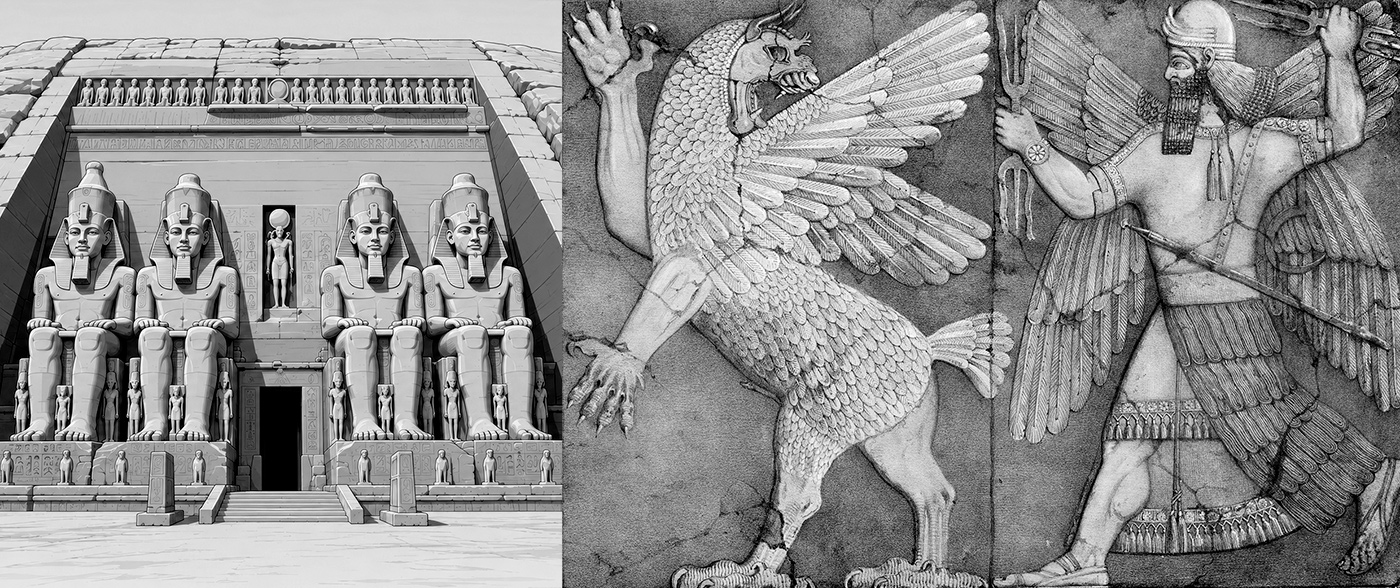
Illustration. Game symbols from the ancestors of the Game. 1) A drawing of the façade of the temple of Ramses II. Upper Egypt, near the border with Sudan. ~1264 B.C. 2) A drawing based on a bas-relief discovered during excavations in Mesopotamia. A story from the “Enuma Elish”. The Monster of Chaos and the Sun God.
Biblical Monotheism: The Two-Layer Matrix of the Game. The 2:2 Scheme as Interpreted by the Triad
The Christian (Old Testament) cosmogony of the Book of Genesis presents the process of creation as a high-tech, two-layer engineering blueprint. The text operates within a flawless 3:3 mirror scheme: the first triad of days creates spaces and coordinates (containers), while the second fills them with actors and managerial functions (filling).
- One: In the beginning, “the earth was formless and empty, and darkness was over the surface of the deep” (Gen. 1:2). The absolute singularity of the unmanifested — the state of the system before the “Start” button is pressed.
The First Triad (Days 1–3) — The Geometry of the Stage (Containers):
In this phase, three mutually perpendicular dualities unfold sequentially, forming the volume of the playing field:
- Day 1 (Metaphysics): The creation of Light and its separation from Darkness. The fundamental declaration of the game’s polarities — the basic binary code of the Game (Light / Darkness).
- Day 2 (Vertical): The creation of the “firmament” separating the upper and lower waters. The vertical axis of hierarchy appears: Top / Bottom.
- Day 3 (Horizontal): The gathering of the lower waters and the emergence of land with vegetation. The horizontal axis of the material field (Land / Sea) is formed — a dense physical foundation.
Summary of the first triad: In three steps, a three-dimensional coordinate grid is established — a fully marked-out but as yet empty playing field.
Second Triad (Days 4–6) — Functions and Actors (Filling):
The second phase mirrors the geometry of the first, translating abstract coordinates into the plane of action:
- Day 4 (Mirror of Day 1): Creation of the Sun, Moon, and stars. Control Centers (Luminaries) are established within the binary code of Light and Darkness. They receive the mandate to “rule over day and night”, ground metaphysics in the physical chronotope, and start the Game’s main timer. This is the establishment of the Center that regulates the rhythm of the entire system.
- Day 5 (Mirror of Day 2): Populating the vertical levels of access. The airspace of the “upper waters” is filled with birds, and the water space of the “lower waters” with fish. Dynamic actors occupy their hierarchical levels, created on Day 2.
- Day 6 (Mirror of Day 3): Filling the horizontal material stage with land animals.
The Crown of the 3:3 Matrix: It is symbolic that at the very end of the mirror cycle — at the close of the sixth day — Man is created. He physically belongs to the land (3/6 day), but bears within himself the “image and likeness” of the Source. Man completes the entire system, acting as the Main Player and final operator, endowed with the function of controlling the entire manifested matrix.
- The seventh day — Rest: The perimeter is finally closed. The system transitions from programming and testing mode to active autonomous Game mode.
Instead of a chaotic polytheistic pantheon, a pure systemic algorithm is revealed here: from the One, through the mirror-like doubling of the axes (3:3) and the fixation of the Center, an ordered set of forms is born, where Man occupies a strictly calculated position — the position of the viceroy and the primary user of the created architecture.
What does this mean for the Game
This is exactly how Game architecture works.
- First, there is a unified foundation.
- Then — its division into opposites.
- Then — the emergence of a center that holds the tension.
- And then — multiple forms, cultures, symbols, zones, roles, and masks.
This is precisely why duality, the triad, and multiplicity are not separate phenomena, but successive stages of a single process.
- First, division arises.
- Then — balance.
- Then — the unfolding into multiplicity.
The Daoist formula is important here not as an external quotation, but as a concise and precise confirmation of a universal law:
- The Tao gave birth to the One,
- The One gave birth to the Two,
- Two gave rise to Three,
- and the Three gave rise to ten thousand things.
This schema does not belong exclusively to China. It is simply formulated particularly succinctly in the Taoist tradition. But the logic itself is ancient and broader. We already see it in Egypt and Mesopotamia, that is, in the progenitors of the Game.
Why this is fundamentally important
All the visible diversity of the world is precisely those “ten thousand things”, born from a single source through the mechanism of mirroring.
Mesopotamia and Egypt are not two random civilizations. They are the first great manifestation of the pattern of the One, divided into mirror forms. All subsequent empires, states, religions, and cultures are a further fractal unfolding of the very same matrix.
They may speak different languages, worship different gods, and wear different masks. But within them operates the same structure:
- a single source,
- division into pairs,
- maintenance through a triad,
- further mirror-like multiplication.
A modern illustration: binary code
The most vivid example of this principle in the modern world is binary code, upon which the entire digital reality is built.
Here, everything begins with minimal duality: 0 and 1.

This is the simplest mirror pair. One symbol signifies presence, the other — absence. It is from this basic division that all further diversity is built: data, algorithms, operating systems, the internet, artificial intelligence, movies, social networks, financial markets, and entire virtual worlds.
All the digital diversity of the modern world is a fractal multiplication of a single pair. A computer does not operate directly with “ten thousand things”. It works through a binary foundation, and everything else is already a derivative level of the Game.
This example is particularly valuable because it shows that even in the most advanced technology of the 21st century, the same ancient scheme operates that was laid down in the Game’s progenitors. The media change, but the principle remains the same.
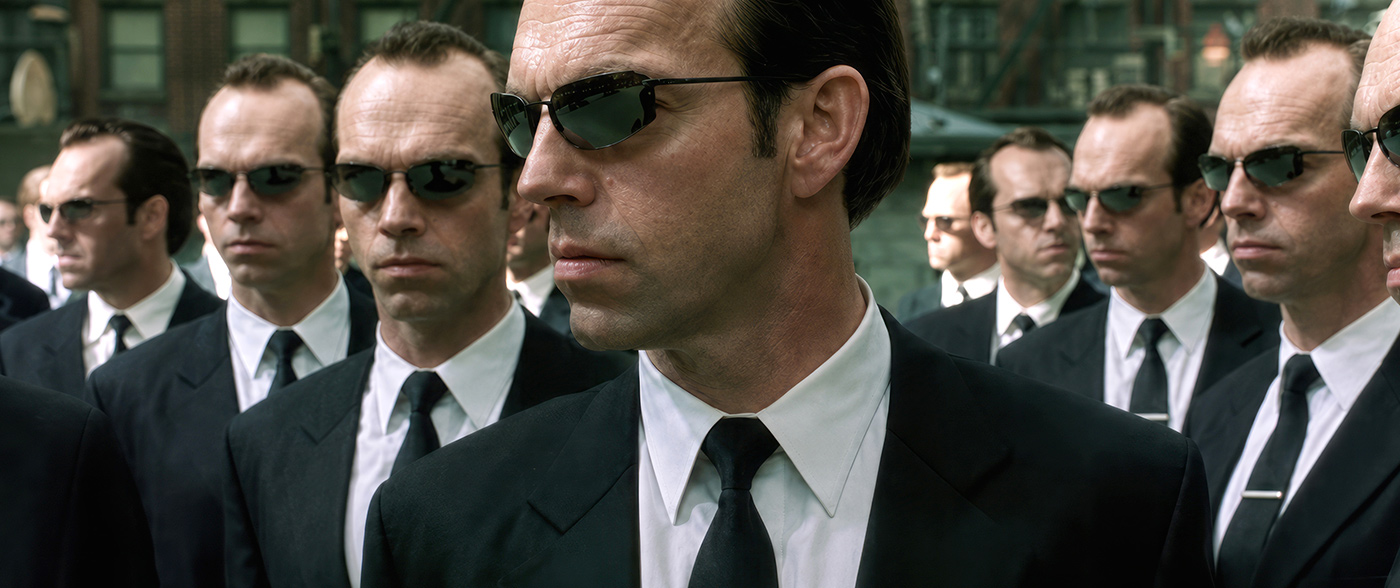
Illustration. “The Matrix” as a model of a unified field and the capture of hosts
The figure of Agent Smith is particularly important because he demonstrates not merely mirroring, but the intrinsic ability of a unified structure to replicate and inhabit new bodies. Smith does not appear as an external intrusion. He is part of the same common field from which the hero, the antagonist, and the very possibility of conflict are born. This is precisely why his replication is not accidental: he does not “break” the system, but pushes its own law to the limit.
When Smith begins to replicate himself and inhabit human bodies, the film reveals the fundamental principle of the Game: the mask is not tied to a single host. If the structure is unified, then it has the right to take on new forms, occupy new bodies, and reproduce itself through them. In this sense, Smith is not merely Neo’s enemy, but one of the forms of the common field, which has unfolded into a captivating, omnipresent, and self-reproducing mask.
Therefore, the scenes with multiple Smiths are not just a scale effect. They are a visualization of how a single principle, having taken form, begins to spread throughout the world via hosts. A single code passes into many bodies, preserving its structure. And this is precisely what makes Smith such a powerful example for our chapter: he demonstrates that mirroring is not a mere ornament, but a mechanism for distributing the same power across different bodies.
The figure of Agent Smith is particularly important because he demonstrates not merely mirroring, but the intrinsic ability of a unified structure to replicate and inhabit new bodies. Smith does not appear as an external intrusion. He is part of the same common field from which the hero, the antagonist, and the very possibility of conflict are born. This is precisely why his replication is not accidental: he does not “break” the system, but pushes its own law to the limit.
When Smith begins to replicate himself and inhabit human bodies, the film reveals the fundamental principle of the Game: the mask is not tied to a single host. If the structure is unified, then it has the right to take on new forms, occupy new bodies, and reproduce itself through them. In this sense, Smith is not merely Neo’s enemy, but one of the forms of the common field, which has unfolded into a captivating, omnipresent, and self-reproducing mask.
Therefore, the scenes with multiple Smiths are not just a scale effect. They are a visualization of how a single principle, having taken form, begins to spread throughout the world via hosts. A single code passes into many bodies, preserving its structure. And this is precisely what makes Smith such a powerful example for our chapter: he demonstrates that mirroring is not a mere ornament, but a mechanism for distributing the same power across different bodies.
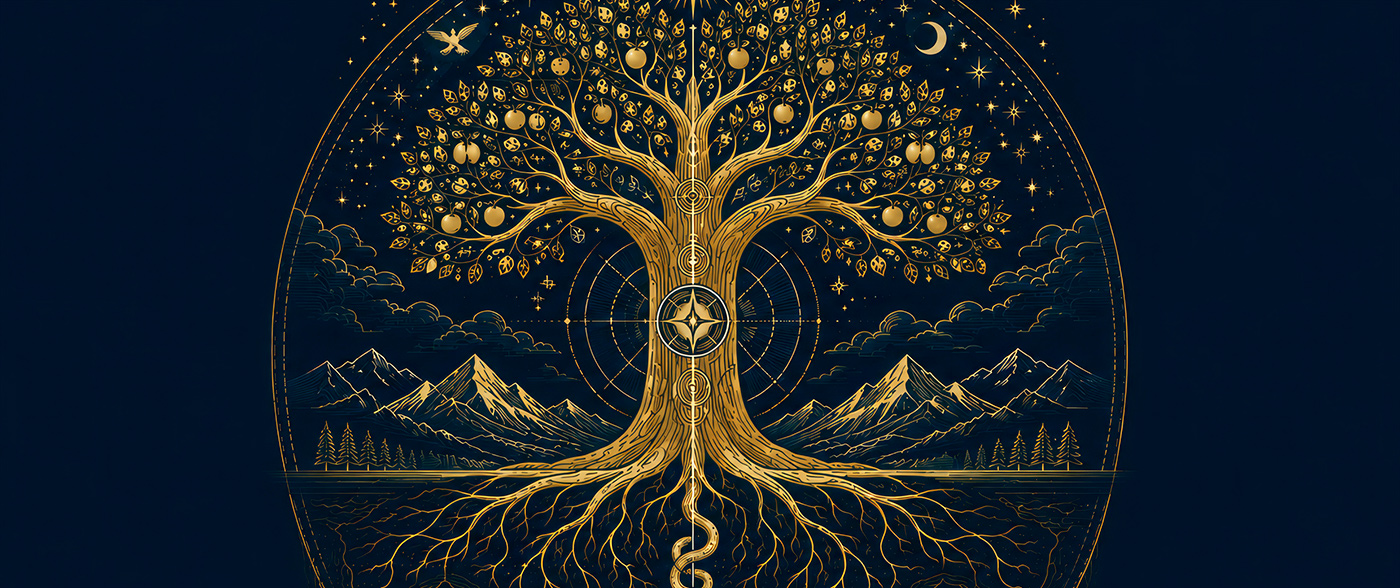
Illustration. The World Tree as an image of the One Source
One of the most precise, ancient, and universal visual manifestations of the formula “One → Two → Three → Many” is the archetype of the World Tree, found in virtually all key civilizational traditions. From the perspective of structural semiotics as developed by V. N. Toporov and his followers, the World Tree is identical to the World Axis (Axis mundi) — the sacred center of the universe that performs a fundamental harmonizing role. Through this image, the basic binary oppositions of meaning that serve to describe the parameters of the world are brought together. The structural architecture of the Tree flawlessly conveys the very mechanics of the Game: its roots extend into the hidden, subterranean, unmanifested part of reality, serving as the primary source of nourishment for the system; the trunk manifests the central vertical axis that maintains balance; and the crown branches upward, generating an infinite variety of forms, branches, leaves, and fruits.
The most important feature of this structure lies in its strict fractal nature. The tree does not remain a static line — from a single foundation, a dual division emerges, in which the trunk and the root anchor the opposing poles of the field. This division instantly crystallizes into a triad (roots — trunk — crown) that holds three levels of existence, after which the system rushes into infinite branching. Each individual branch and each leaf precisely replicates the geometry of the whole, yet never loses its direct energetic connection to the original center. Thus, from the One Source, through polar division and the fixation of the axis, the entire diversity of the observable world arises. The tree becomes more complex, yet remains a single organism — any multi-level move in the Game unfolds according to precisely the same algorithm.
In ancient Egyptian sacred engineering, the Djed pillar performs a similar structuring function — a symbol of stability, unshakable order, and concentrated vertical power, traditionally associated with the spine of Osiris. As a visualization of the world axis, the Djed vividly demonstrates how a single concentrated center holds and synchronizes the different registers of the playing field — from the chthonic underground to the highest celestial.
Thus, the World Tree and the Jed pillar are not religious-poetic metaphors, but precise architectural blueprints of the Game. They clearly prove that any complex reality always unfolds from a single point, splits into mirror opposites, and reassembles itself by maintaining balance, confirming the indivisibility and identity of all elements of the system with the common original source.
One of the most precise, ancient, and universal visual manifestations of the formula “One → Two → Three → Many” is the archetype of the World Tree, found in virtually all key civilizational traditions. From the perspective of structural semiotics as developed by V. N. Toporov and his followers, the World Tree is identical to the World Axis (Axis mundi) — the sacred center of the universe that performs a fundamental harmonizing role. Through this image, the basic binary oppositions of meaning that serve to describe the parameters of the world are brought together. The structural architecture of the Tree flawlessly conveys the very mechanics of the Game: its roots extend into the hidden, subterranean, unmanifested part of reality, serving as the primary source of nourishment for the system; the trunk manifests the central vertical axis that maintains balance; and the crown branches upward, generating an infinite variety of forms, branches, leaves, and fruits.
The most important feature of this structure lies in its strict fractal nature. The tree does not remain a static line — from a single foundation, a dual division emerges, in which the trunk and the root anchor the opposing poles of the field. This division instantly crystallizes into a triad (roots — trunk — crown) that holds three levels of existence, after which the system rushes into infinite branching. Each individual branch and each leaf precisely replicates the geometry of the whole, yet never loses its direct energetic connection to the original center. Thus, from the One Source, through polar division and the fixation of the axis, the entire diversity of the observable world arises. The tree becomes more complex, yet remains a single organism — any multi-level move in the Game unfolds according to precisely the same algorithm.
In ancient Egyptian sacred engineering, the Djed pillar performs a similar structuring function — a symbol of stability, unshakable order, and concentrated vertical power, traditionally associated with the spine of Osiris. As a visualization of the world axis, the Djed vividly demonstrates how a single concentrated center holds and synchronizes the different registers of the playing field — from the chthonic underground to the highest celestial.
Thus, the World Tree and the Jed pillar are not religious-poetic metaphors, but precise architectural blueprints of the Game. They clearly prove that any complex reality always unfolds from a single point, splits into mirror opposites, and reassembles itself by maintaining balance, confirming the indivisibility and identity of all elements of the system with the common original source.