2. The Two Civilizational Poles of the Middle East
By the beginning of the period under consideration (16th–14th centuries BCE, or 1600–1301 BCE, the Late Bronze Age), a stable bipolar system had already taken shape in the Middle East. It is precisely at this time that we observe a relatively “clear-cut” configuration of the playing field: two powerful centers of civilization dominate the region, while the remaining players carry significantly less weight.
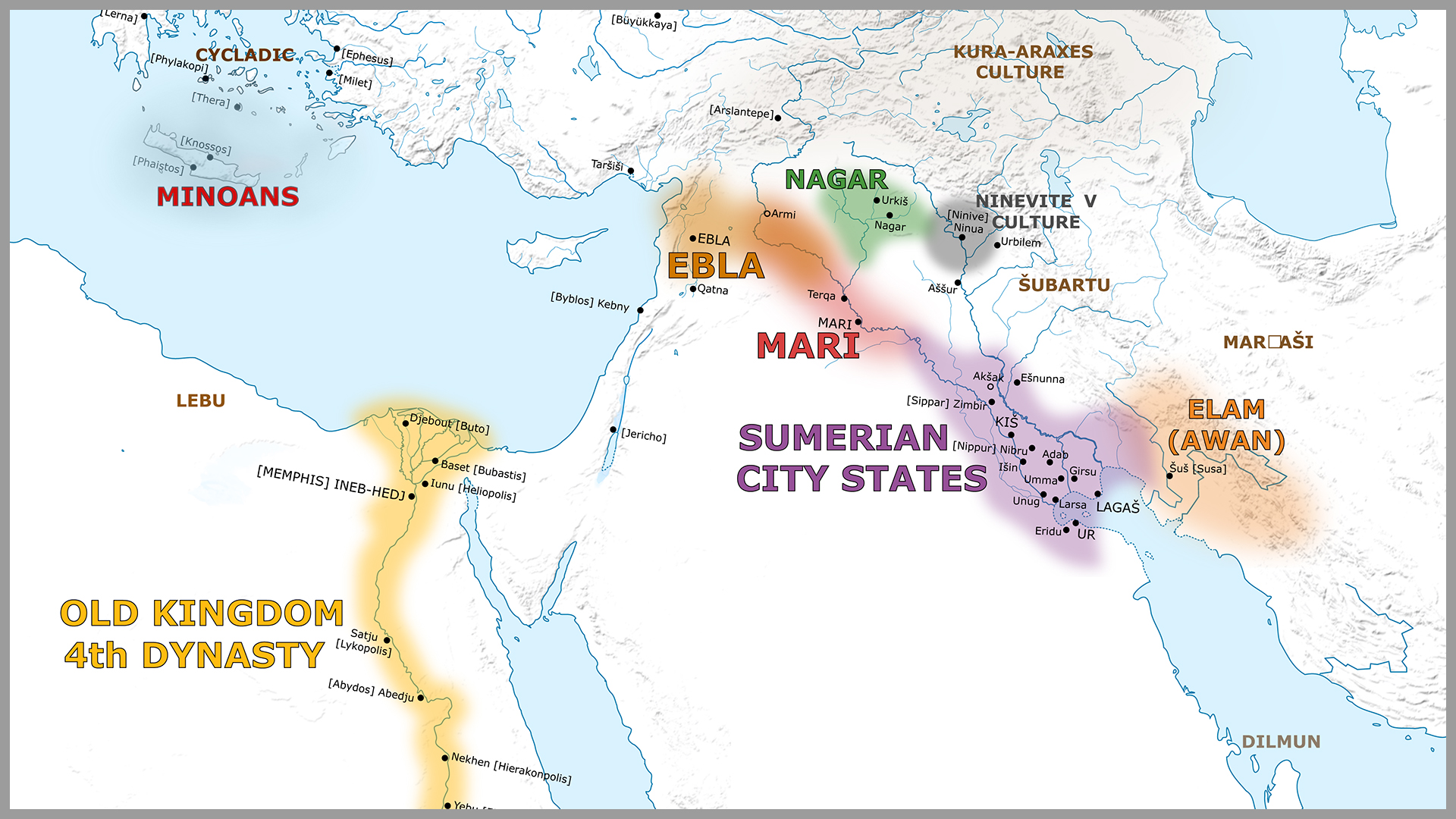
Illustration.
Approximate reconstruction. The Ancient East around 2500 BCE: the Old Kingdom in Egypt (4th Dynasty); the peak of pyramid construction / Ebla versus Mari / Sumerian city-states versus the Elamites. Author of the original diagram: Enyavar (Germany).
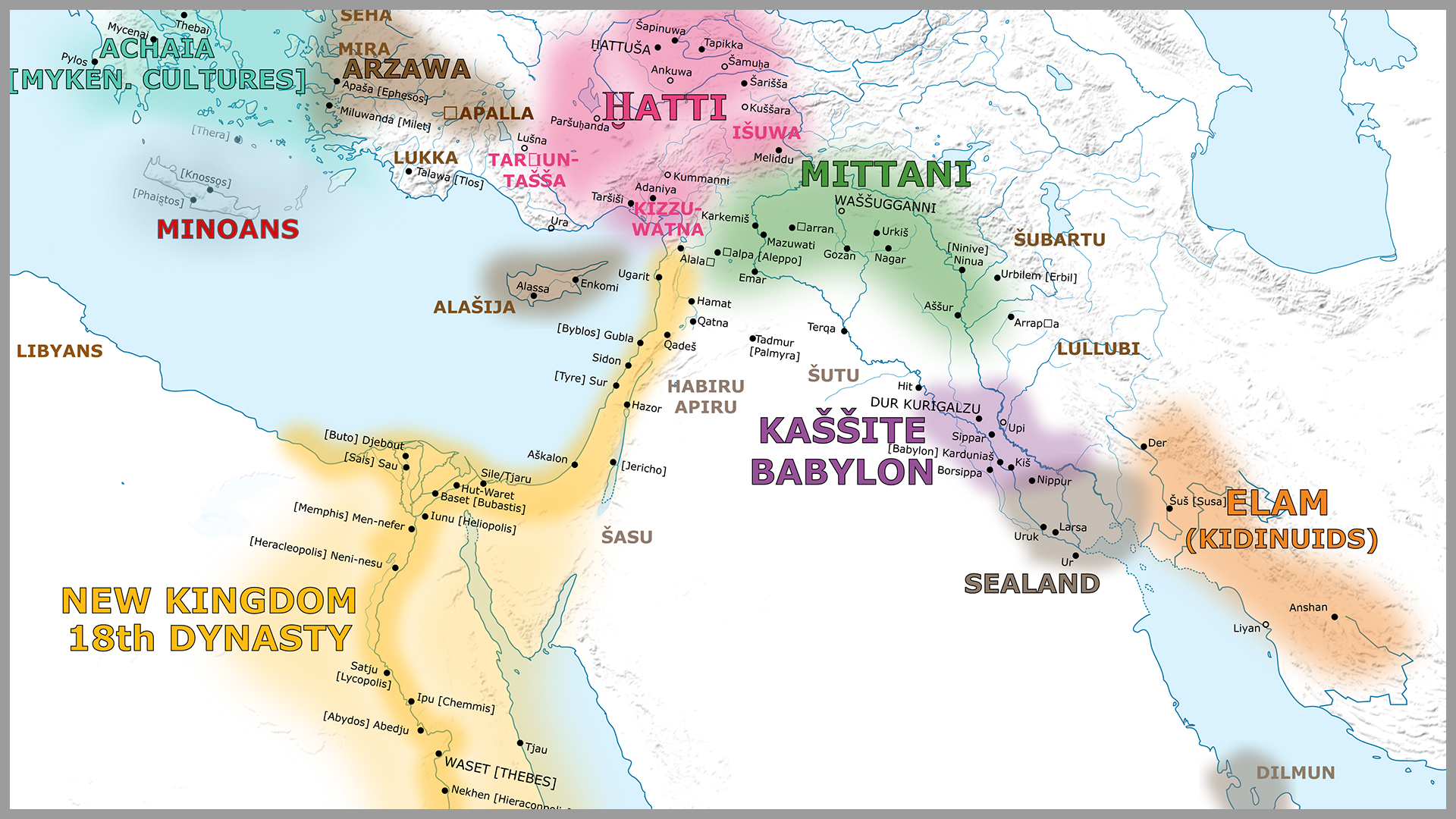
Illustration.
Approximate reconstruction. The Ancient Near East around 1500 BCE: Egyptian (New Kingdom, 18th Dynasty) expansion into the Levant and rivalry with the Hatti and the Mittani. The Kassites (Kassite Babylon) in conflict with Elam. Author of the original diagram: Enyavar (Germany).
Pole 1: Mesopotamia (a polycentric system of three Middle Eastern powers; a first-order civilizational core)
The Mesopotamian macroregion constituted a politically polycentric system in which three major states played leading roles at various times: Kassite Babylon, Mittani, and Assyria. Their relative influence fluctuated, yet it was these states that determined the military-political configuration of Upper and Lower Mesopotamia.
- Cassite Babylon (Karduniash) was the most stable power in Southern Mesopotamia. It maintained high cultural prestige as the guardian of ancient Mesopotamian tradition. It controlled the southern and central parts of Mesopotamia, possessed a powerful agricultural base (irrigated farming, the cultivation of barley and date palms), a developed textile industry, and participated in long-distance trade networks linking Mesopotamia with the Iranian Highlands and the regions through which lapis lazuli was imported.
- Mitanni (the Hurrian Kingdom) — the leading military power of Northern Mesopotamia and Syria. It dominated the northern Mesopotamian plain and a significant part of Syria thanks to the high level of training of its charioteers, advanced horse breeding, control over important trade routes between Upper Mesopotamia, Syria, and Anatolia, as well as its reliance on the military aristocracy (the Mariannu).
- Assyria (Middle Assyrian period; the city-state of Ashur) — a state that gradually built up its military and political power. It was relatively dependent on Mitanni but enjoyed a favorable strategic position on the middle reaches of the Tigris, had well-developed trade traditions, and was shaping a state ideology that justified territorial expansion.
Mesopotamia as a whole constituted a self-sufficient, internally competitive macroregion possessing advanced military technologies, vast agricultural resources, and developed logistics.
Pole 2: Ancient Egypt (monocentric superpower; first-order civilizational core)
During the same period, Egypt of the New Kingdom (18th Dynasty) was the complete opposite of the polycentric system of powers in the Near East — a monolithic, highly centralized state.
Power was concentrated in the hands of the ruling elite, who hailed from Thebes. The pharaoh acted as an absolute, sacred monarch, supreme commander-in-chief, the earthly incarnation of the god Horus, and the son of the god Ra. The administrative apparatus and the priesthood were largely subordinate to the central authority, ensuring a high degree of political unity within the state.
- The imperial heartland: the Nile Valley from Aswan to the Delta.
- Southern Direction: Nubia (Kush) was fully incorporated into the Egyptian empire and served as a vital resource province, primarily as a source of gold and other natural riches.
- Northeast: Control extended through the Sinai into the southern Levant and reached the southern regions of Syria, supported by a network of fortresses, garrisons, and vassal city-states.
Egypt enjoyed exceptionally high food security thanks to the regular flooding of the Nile, controlled the largest gold deposits in Nubia, mined its own deposits of copper and building stone, maintained a professional army with effective chariot units and composite bows, and possessed a well-developed river and maritime logistics system.
Assessment of Potential Competitors
In the early phase of the Late Bronze Age (16th–15th centuries BCE), other major states in the region were not yet able to compete on equal terms with the leading centers of power in Egypt and Mesopotamia.
- The Hittite Kingdom was undergoing its Middle Kingdom period, marked by dynastic crises and constant raids by the Kaska. Despite a successful campaign against Babylon around 1595 BCE, the Hittite rulers had not yet established a stable system of governance over their vast conquered territories. It was not until the second half of the 14th century BCE, under Suppilulium I, that the Hittite Kingdom emerged as one of the leading powers in the Near East. But by the end of the 8th century BCE, Assyria had completely absorbed the last remnants of Hittite territory, thereby cementing Mesopotamia’s dominance in the region once and for all.
- The Minoan/Mycenaean civilization consisted of a network of palace states whose economies were based on agriculture, crafts, and active maritime trade. They played a significant role in international exchange in the Eastern Mediterranean; however, their political influence and the scale of their military organization were inferior to those of the major states of the Near East.
Thus, if we consider not individual states but stable civilizational-geographical centers, Egypt and Mesopotamia remained the two main macroregional zones of the Near East throughout the entire period under consideration. The specific political entities that controlled these territories changed repeatedly, but their geographical, demographic, and economic foundations maintained continuity.
This is precisely why this study distinguishes between
civilizational poles — long-term centers of concentration of resources, population, and state tradition. The rise of the Hittite Kingdom, Assyria, or other powers altered the political balance of power but did not negate the fundamental significance of Egypt and Mesopotamia.
Next section of the chapter: