1. Introduction. Methodological Notes and Key Concepts
Christ emerges at the central node of the most interconnected, information-rich, and geopolitically tense geographical system of the ancient world. Along with him, this chapter focuses on the territory where this took place —
ancient Israel (Canaan).
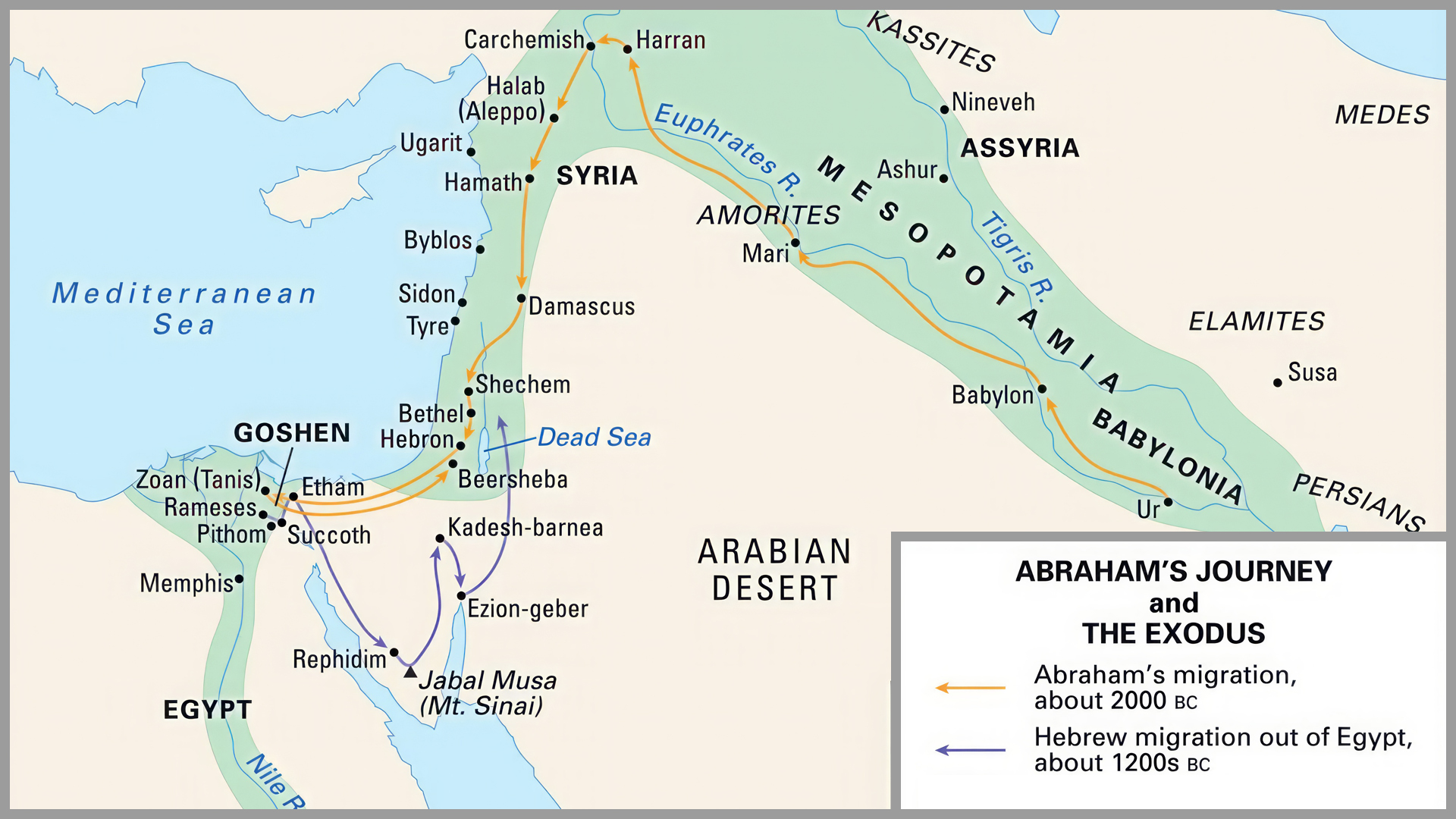
Illustration.
A map showing the possible routes by which Abraham traveled from Mesopotamia to Canaan, as well as those taken by Moses and the Israelites during their exodus from Egypt to Canaan.
The emergence of Christianity has traditionally been explained either as a theological breakthrough (“revelation in a vacuum”) or as a fortuitous convergence of circumstances within the Roman Empire. A systemic-historical analysis requires a different perspective. To understand why this event occurred precisely here, we must focus on what has remained constant over the millennia —
the geographical invariant.
From the dawn of civilization in the Old World, a stable macrostructure has emerged in the region, which we define as
the “Game Triad”. The main trajectories of wars, trade routes, technological diffusion, and cultural exchange here were determined by the interaction of three elements: two powerful gravitational poles and the transit corridor connecting them.
For a rigorous analysis, we introduce a clear terminological distinction between three levels:
- Civilizational cores (poles) — stable geographical, demographic, and economic centers: the Nile alluvial valley (Egypt) and the Tigris-Euphrates basin (Mesopotamia). These cores have maintained their resource base and civilizational significance for millennia, regardless of changes in dynasties.
- Imperial operators — specific political entities that, in different eras, took control of the cores and the arteries connecting them (Assyria, Babylon, Persia, the Hellenistic kingdoms, Rome, etc.).
- The Levantine Corridor (Levantine Supernode / Canaan / ancient Israel) is a stable geographical hub wedged between the Mediterranean Sea and the Syrian Desert. Its historical role and exceptional symbolic significance are determined not by its own military power, but by its unchanging position as a bridge between the two main poles.
Within this model, the history of the Middle East appears not as a chaotic succession of empires, but as a sequence of actors operating within the same spatial structure. The poles generated material, administrative, and mythological resources. The Levantine Corridor served as a
“Persistent Hub” — a stable transit node capable of withstanding radical systemic changes.
It is precisely here, at this unique point where material, political, and symbolic flows converge, that what the ancient Israelites themselves called “chosen-ness” takes shape. In the context of systems analysis, this is not merely a religious metaphor, but an accurate description of the region’s actual situation:
technically the most suitable place for the accumulation, synthesis, and subsequent transmission of civilizational codes. Through myths, prophecies, and sacred texts, Canaan/Israel instilled in its culture an awareness of its centrality — from the “navel of the earth” (Tabbur ha-Aretz) to “Jerusalem, set in the midst of the nations” (Ezek. 5:5).
By the beginning of our era, during the Pax Romana, the political center of gravity had shifted westward. However, the new empires operated in a world where the Egyptian and Mesopotamian cores had already established fundamental models of human existence. It is precisely at this super-node, at the intersection of the ancient lines of power of the Playful Triad, that the phenomenon of Christianity emerges. The figure of Jesus Christ and the logic of the New Testament became the apex of the Levantine Corridor’s network centrality — the moment when information accumulated over centuries was integrated and presented to the world in a universal form.
In this chapter, we will show how the geography, infrastructure, and centuries-long cultural synthesis of the Levant made ancient Israel and the Christianity that emerged on its territory not accidental phenomena, but the natural result of the workings of one of the most powerful systems of the ancient world.
Next section of the chapter: