Why Christ Appeared Right Here: The Levantine Supernode
Christ emerges at the central node of the most interconnected geographical system of the ancient world. Technical Documentation.
To understand the architecture of the processes under consideration, it is necessary to return once again to the basic mechanics of the Alpha Game Triad. This model describes a universal algorithm: as a result of an artificially constructed hypothetical conflict between two initial poles, a third component is inevitably generated. This third element performs a strictly utilitarian, stabilizing function — it is precisely this element that serves as the “Star” in the game context.
IllustrationIllustration.
The Classical Triad. Black and white can be used instead of blue and red — as desired.
All hierarchical pyramids are built according to this principle, including the construction of symbolic values. This is most clearly seen in the example of gold, precious metals, and gemstones: their global value is not a natural given, but a classic pyramid, structurally and sequentially constructed by the Alpha Players.
Illustration.
The pyramid and the star that crowns it.
On a visual and cosmogonic level, this mechanism is demonstrated by the model and central philosophy of the solar arc: between the points of sunrise and sunset lies a point of maximum intensity — the zenith. In game philosophy, where the image of the sun directly personifies the Star, the zenith marks the highest point of balance. From this arises the color yellow as the basic systemic marker of the middle, the angle, and the apex.
Illustration.
The classic and basic solar arc.
From this perspective, we turn to a deconstruction of the Middle Eastern node to technically identify three key parameters:
The reasons why the Levant (Canaan) region acquired its unique status on the board. That is, we are directly examining the area of Israel.
The technological nature of the concept of the “chosen people” of the Jewish nation and the strict association of this concept with the circle of individuals marked in “yellow”.
The origin of the figure of Jesus Christ as an extremely technical, calculated project created for a specific game situation.
It is important to immediately strip away any theological and metaphysical layers: there is no sacred “chosen status” here. We identify two basic geographical game cores (poles) — the Mesopotamian macroregion (as the zero point, the progenitor of the Game) and Ancient Egypt (as the first great mirror). It is precisely the interaction between these two heavyweights that generates a third, buffer zone between them — Canaan. The philosophy of the Game automatically assigns this third zone the status and utilitarian function of a “Star”. At the same time, in reality, we see Players who are absolutely equal in spirit, with each side strictly fulfilling the systemic role assigned to it.
Illustration.
Jesus’s playing field as the zenith between two opposites: Mesopotamia and Ancient Egypt.
Here, too, a crucial law comes into effect: as proven in our earlier studies, a triad generates a fractal world. A dual system (two poles) is sterile. Multiplicity and fractal structure are triggered only when three elements form a unity. It is precisely this fractal mechanism that symbolically makes the region of Canaan and the figure of Jesus Christ who emerged there central, axial elements in the global “game” environment. This is not mysticism, but pure symbolic, geopolitical, and systemic engineering.
Illustration.
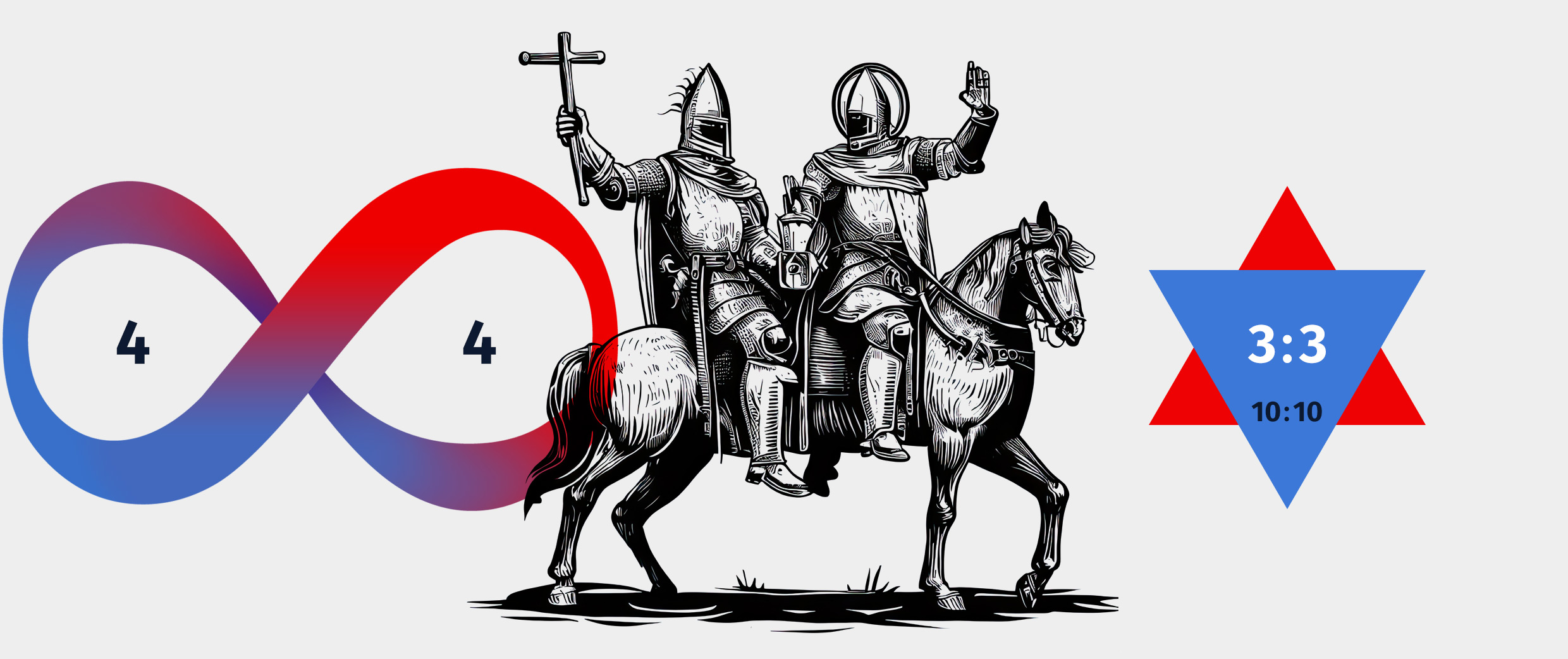
A metaphor for the opposites of the Games and their center. Note: the “upward-pointing” triangle is an excellent image for Ancient Egypt, while the “downward-pointing” triangle serves as a metaphor for Mesopotamia. Such a structure perfectly aligns with the mechanics of the Games and is valid in conjunction with the current imagery. This additional technique only enhances the multitude of meanings embedded in the Star of David.
The Levant as a Crossroads of Civilizations: A Scientific Perspective
The view of ancient Canaan (the Levant) as a meeting place for the major civilizations of the ancient world has long been accepted in the fields of archaeology and the history of the ancient Near East. Modern researchers repeatedly emphasize that it was precisely the region’s geographical location between Egypt and Mesopotamia that determined its exceptional historical role.
American archaeologist William G. Dever, in his works "Who Were the Early Israelites and Where Did They Come From?" (2003) and “Beyond the Texts” (An Archaeological Portrait of Ancient Israel and Judah; 2017), repeatedly characterizes Canaan as a cultural and political bridge between Egypt and Mesopotamia, through which major flows of people, trade, technology, and religious ideas passed over the course of millennia.
In his seminal work "Archaeology of the Land of the Bible", Israeli archaeologist Amihai Mazar views the territory of ancient Israel as an integral part of the international system of the Eastern Mediterranean, constantly embedded within the sphere of interaction between Egypt, Syria, Anatolia, and Mesopotamia.
Archaeologist Israel Finkelstein, in his study of the origins of Israel and Judah, repeatedly emphasizes that their formation took place at the crossroads of the interests of the major powers of the ancient East. The political history of the region was almost always shaped by the interactions of its more powerful neighbors.
In his book "The Ancient Near East: History, Society, and Economy", Italian historian Mario Liverani describes the Levant as an “intermediate zone” between the great powers of Egypt and Mesopotamia, where trade routes, diplomatic contacts, armies, and cultural influences constantly intersected.
Many other specialists in the ancient Near East offer a similar assessment. Nadav Na'aman examines Canaan as a space where Egyptian, Syrian, and Mesopotamian political systems interacted. Donald B. Redford explores the millennia-long contacts between Egypt and the Levant via the Sinai land bridge. Eric H. Cline portrays the Eastern Mediterranean of the Late Bronze Age as a unified international system. Trevor Bryce analyzes in detail the struggle between Egypt, the Hittite Kingdom, and the Syro-Palestinian states for control of the Levant. Aaron A. Burke demonstrates the interconnectedness of Egypt, Mesopotamia, and the Levant through the development of the region’s defense and communication systems.
Thus, academic research provides a comprehensive review of the facts: the Levant was never an entity in and of itself. It originally functioned as a transit hub, sandwiched between two global civilizational centers.
Let us now turn to a detailed examination of the parameters of these centers to see exactly how their competitive pressure shaped the internal structure of Canaan.