3. The Architecture of Transit: The Shift in Imperial Actors and the Emergence of a Stable Hub
The history of the Middle East is not merely a sequence of empires rising and falling, but a process of the successive exploitation of the same geographical invariant. If we view the map not as a mosaic of successive states but as a dynamic, distributed network, the period from the Late Bronze Age to the 1st century CE appears in a completely different light.
Each great power of antiquity had its own system of government, army, tax model, ideology, and language. Nevertheless, they all functioned as
imperial operators of the same backbone network, anchored to two constant civilizational poles and connected by the Levantine Corridor.
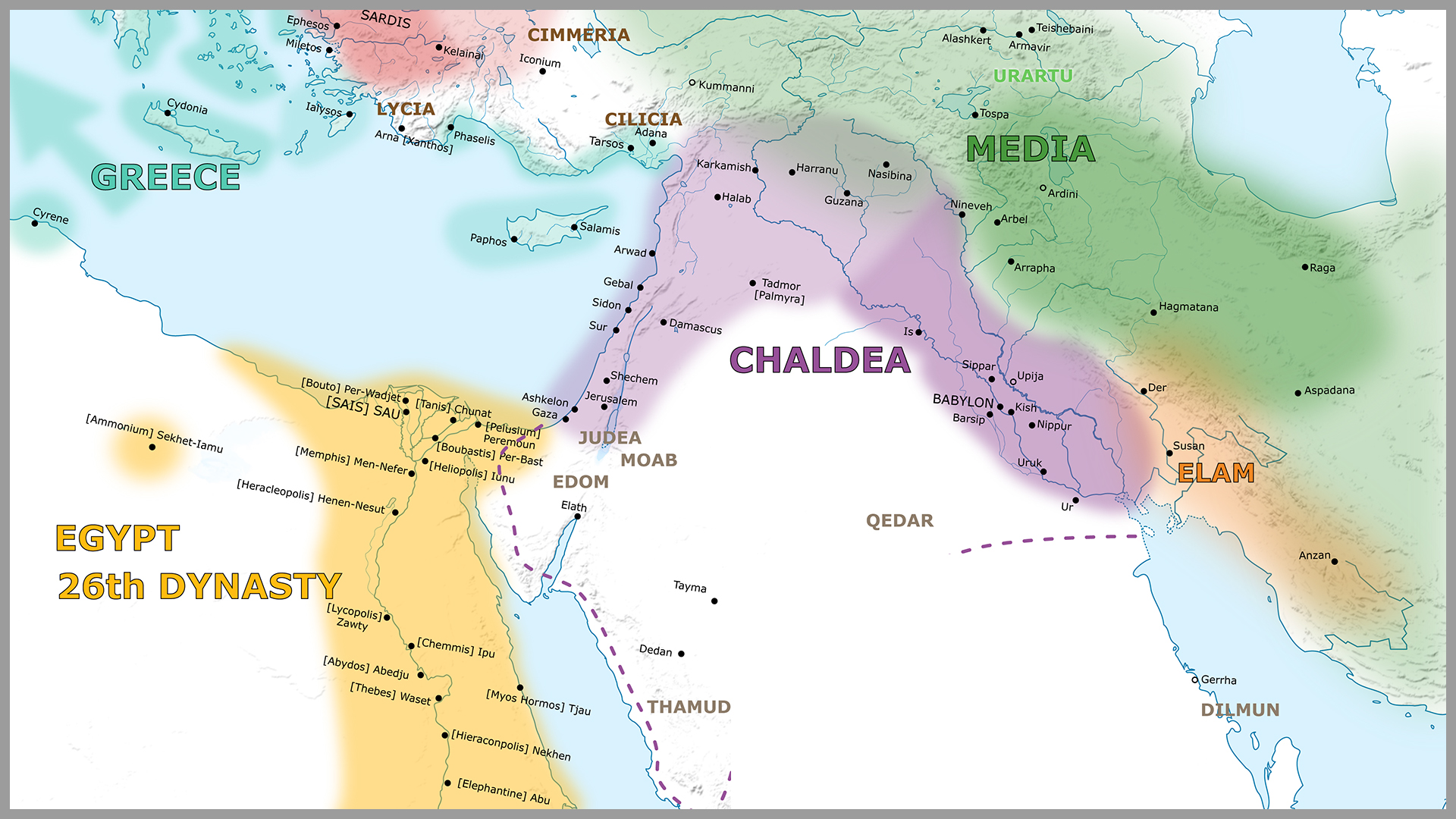
Illustration.
Approximate reconstruction. The Ancient East around 600 BCE: the Late Saite Dynasty (Egypt’s 26th Dynasty) / Nebuchadnezzar’s Chaldean Empire (Chaldea) / the Median Empire (Media) / Lydia / Greek colonization. Original diagram by Enyavar (Germany).
Immutability and Constancy
Changes in the imperial operators of the transit system never meant the disappearance or erasure of the original zones. Egypt and Mesopotamia were not random or temporary states of early antiquity. It was precisely in these alluvial (river) valleys that the world’s first major centers of population concentration, irrigation agriculture, state administration, writing, and long-term governance of large territories emerged.
Subsequent macro-political structures did not emerge in a geographical vacuum:
- Assyria and Babylon were direct territorial and cultural continuations of the Mesopotamian region.
- The Achaemenid Persian Empire was the first to unite Mesopotamia and Egypt under a single state, incorporating both civilizational centers into a unified administrative system.
- After the campaigns of Alexander the Great, both of these regions retained their significance within the Hellenistic world: Egypt became the foundation of the Ptolemaic Kingdom, while Mesopotamia became the heart of the Seleucid Empire.
- Later, Egypt became part of the Roman Empire, while Mesopotamia remained the subject of prolonged rivalry between Rome, Parthia, and Sassanid Iran, retaining key strategic importance for all the major powers in the region.
In other words, over the course of millennia, political centers, capitals, ruling dynasties, and forms of government changed, yet the civilizational cores of Egypt and Mesopotamia retained their fundamental importance as the greatest centers of population, economic production, cultural continuity, and administrative tradition in the Ancient East.
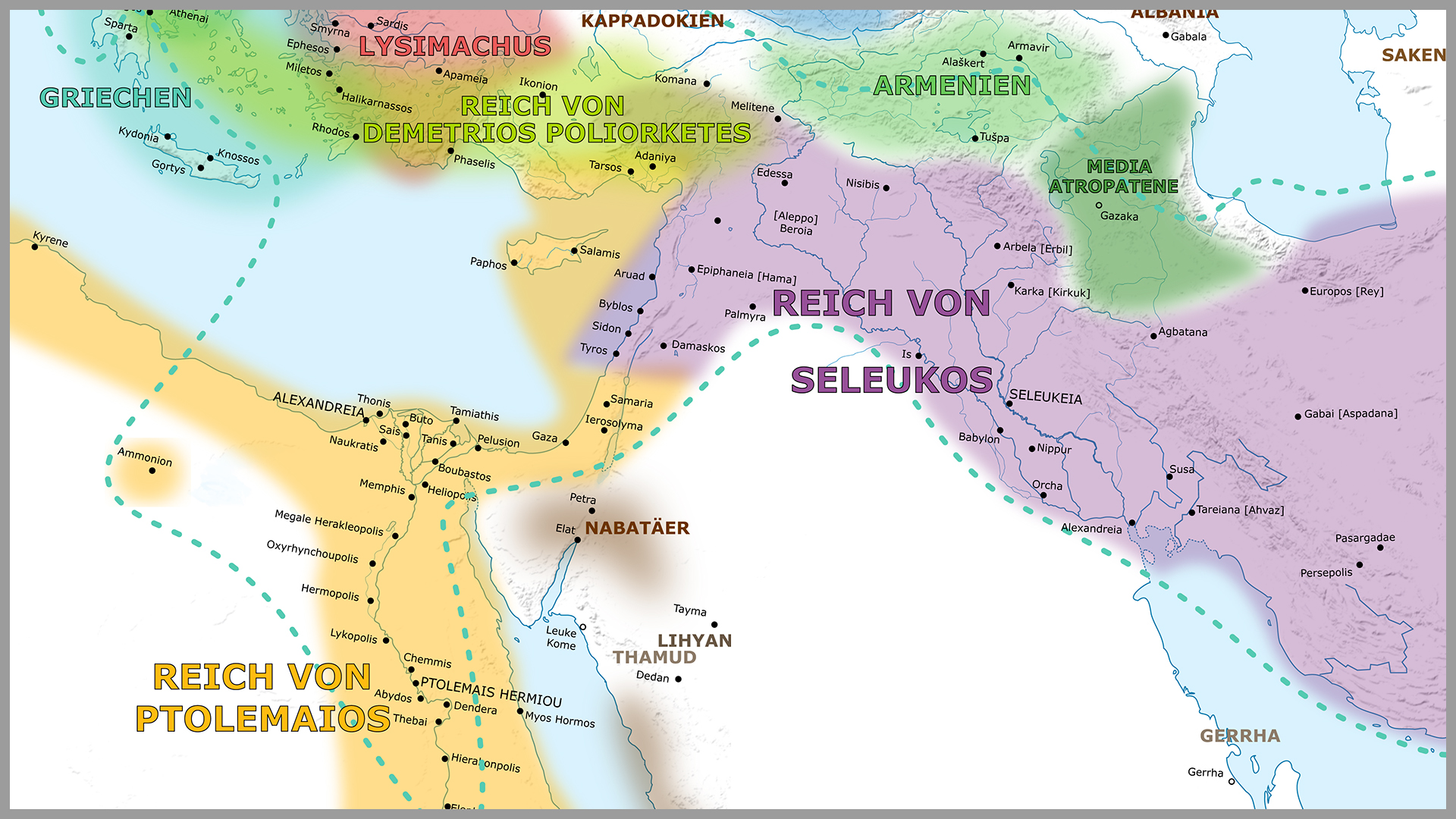
Illustration.
Approximate reconstruction. The Ancient East around 300 BCE: Alexander’s empire (outline); the kingdoms of the Diadochi: the Ptolemies (Reich von Ptolemaios) / the Seleucids (Reich von Seleukos) / other rivals. Author of the original diagram: Enyavar (Germany).
The Levantine Corridor as a Persistent Hub
Since the two main Players remained constant, the space between them acquired a property that, in systems analysis, is classified as a
“Persistent Hub” — a stable transit hub capable of surviving radical upheavals in the systems that encompass it.
In other words, the Levantine Corridor acquires the properties of a persistent transit hub — a spatial invariant that retains its function regardless of changes in political systems.
History reveals a curious asymmetry. Political centers arose, shifted, and disappeared: Nineveh was destroyed, Babylon lost its significance, Persepolis was burned to the ground, and Memphis and Thebes became historical monuments. However, the Levantine Corridor could not “disappear” in this way. Its significance was determined not by a capital or a dynasty, but by the very geometry of space. As long as the empires of Egypt and Mesopotamia existed, the overland bridge between them retained its systemic function.
Canaan remained one of the most stable transit hubs of the ancient Oikoumene, regardless of which state controlled it during any given historical period. Its high betweenness centrality was determined primarily by its geographical location and spatial topology, whereas changes in political regimes mainly altered the nature of the hub’s use, but not its basic function.
- The Egyptian-Mesopotamian bipolar system (Early Bronze Age). Two basic civilizational cores took shape, and the Levant functioned as the zone of their initial contact, exchange, and interaction.
- The Assyrian model (Iron Age). The dismantling of the political autonomy of the Syro-Palestinian kingdoms and the incorporation of the Levant into the unified military-administrative system of the continental empire.
- The Neo-Babylonian phase (6th century BCE). The deportation of part of the local elites and the incorporation of the region into the empire-wide cultural and administrative space. Under these conditions, written and religious traditions took on special significance as mechanisms for preserving collective identity.
- The Persian route (6th–4th centuries BCE). The unification of Egypt and Mesopotamia under a single empire transformed the Levant from a border region into an important internal transit corridor of the Achaemenid Empire.
- Hellenistic operator (4th–1st centuries BCE). The formation of a common Hellenistic cultural space and the widespread use of Greek as a language of interregional communication, while key transit routes were maintained.
- Roman operator (1st century BCE–1st century CE). The integration of the Mediterranean into a unified political and economic system (Mare Nostrum) and the maximum development of transportation infrastructure linking the Levant with the European, Asia Minor, and Egyptian provinces.
Compulsory Investments and the Emergent Effect of History
Within this structure, the interaction between the operator and the network was governed by strict systemic logic. Each new operator of the backbone network
was forced to invest colossal resources in improving the technical and infrastructural characteristics of the Levantine hub.
At the same time, none of the empires sought to create a universal religious platform for the future. Each pursued exclusively its own military and political objectives. This is precisely why the resulting effect was emergent in nature: the system acquired properties that none of the individual participants in the process had planned for.
This was not a matter of subjective desire, humanism, or the “cultural choice” of rulers — it was a strict condition for maintaining control over the macro-system. Otherwise, it would have been physically impossible to govern an empire linking Egypt, the Mediterranean, and Mesopotamia.
- Assyria did not aim to develop Canaan — it was obliged to maintain a corridor for the uninterrupted collection of tribute and the defense of its distant frontiers.
- Persia did not build imperial roads for the sake of Jerusalem — it ensured direct military and administrative communication between distant satrapies.
- Rome did not create secure maritime logistics and paved roads for the sake of future Christianity — it was solving utilitarian problems of deploying legions and supplying the capital with grain.
However, the objective outcome of these pragmatic imperial strategies was a cumulative
emergent effect (the emergence of new properties in the system that could not be reduced to the properties of its individual elements): each state acted in its own interests, but at the same time increased the institutional, infrastructural, or cultural capacity of the network. The system’s new properties did not arise from the designs of individual rulers, but rather as a result of the successive layering of the political, administrative, and communication structures they had created.
- The Assyrian Operator
- Institutional change: the military-administrative consolidation of the region and the dismantling of the system of independent Syro-Palestinian kingdoms.
- Emergent effect: the sustained integration of the Levant into a unified macro-regional political system and a sharp increase in the intensity of transit links.
-
Neo-Babylonian Operator
- Institutional change: the deportation of part of the local elites and the strengthening of the role of the written tradition in preserving religious and cultural identity.
- Emergent effect: intensification of editorial and codification work on sacred texts, which contributed to the formation of a sustainable written tradition independent of the community’s specific place of residence.
-
Achaemenid Operator
- Institutional change: administrative stabilization of the region and the restoration of local religious institutions within the framework of imperial policy.
- Emergent effect: the return of part of the Jewish population, the reconstruction of the Second Temple with the support of the Persian administration, and the transformation of the province of Yehud into a stable religious and administrative center.
-
Hellenistic Operator
- Institutional change: the spread of the Greek language (Koine) and the formation of a common cultural space in the Eastern Mediterranean.
- Emergent effect: the emergence of a universal language for interregional communication; the translation of Jewish sacred texts into Greek (the Septuagint) made them accessible to a much wider audience.
-
Roman operator
- Institutional change: the political integration of the Mediterranean, the development of a road network, and the assurance of relative security of communications under the Pax Romana.
- Emergent effect: maximum transportation connectivity between the Levant and the major centers of the Mediterranean world; accelerated movement of people, goods, ideas, and texts along empire-wide routes.
Infrastructural Configuration of Point X (1st century CE)
As a result of this gradual, centuries-long upgrade, by the 1st century CE the Levantine Corridor found itself in a unique historical, topological, and engineering position. By the 1st century CE, four independent infrastructure parameters — each shaped by distinct historical processes — converged simultaneously at a single geographical point for the first time:
- The oldest, most deeply developed, and textually documented monotheistic tradition (the Mesopotamian, Babylonian, and Persian heritage).
- A common, standardized language for international communication (the Hellenistic programming interface).
- An extremely well-developed, secure road and navigation infrastructure (Roman infrastructure).
- A colossal density of human and trade flows within a unified political and legal space.
Final Systemic Formula
Regardless of the theological assessment of the religious significance of the person of Jesus Christ and belief in His messianic status, it was precisely this infrastructural configuration of the Levantine supernode that mathematically and logically increased the potential for the spread, survival, and entrenchment of any universalist doctrine originating at this geographical point.
Just as a modern operating system spreads instantaneously across a global network thanks to the pre-existing TCP/IP protocol and fiber-optic cables, the universal informational signal that originated in the Levant in the first century found itself in an environment with ideal conductivity.
As a result of the sequential superimposition of independent historical processes,
an infrastructural environment with exceptionally high bandwidth for the dissemination of universalist ideas
was formed. It was precisely in such an environment that the Christian movement emerged and began to spread.