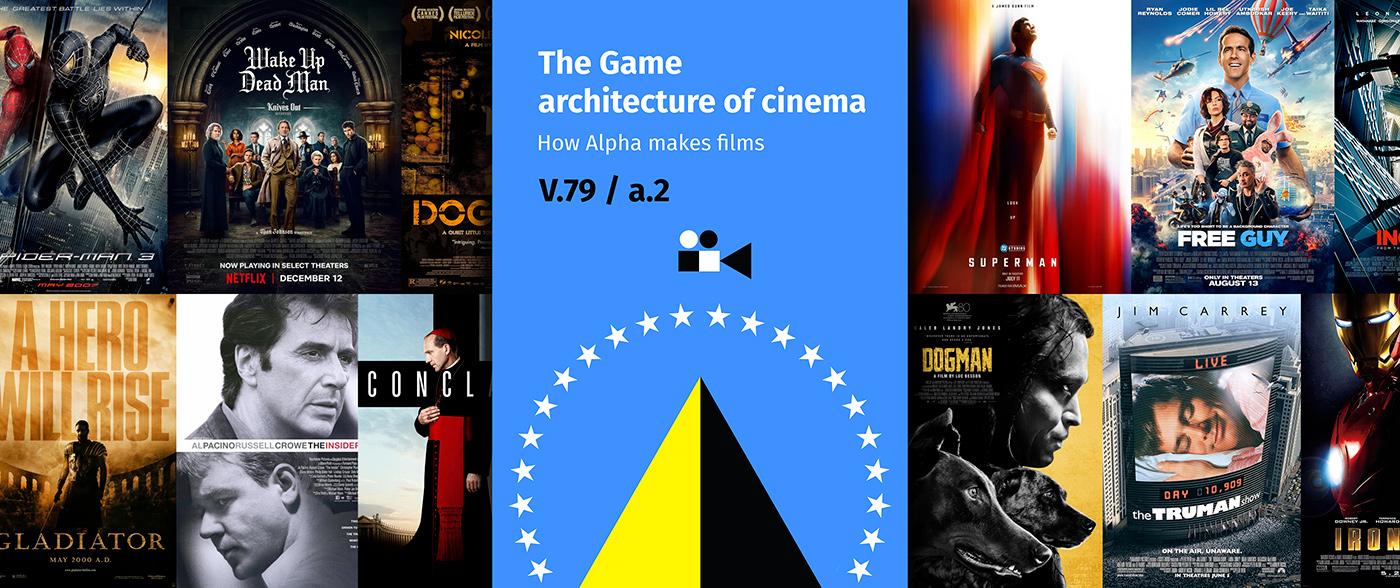
The Game architecture of cinema. How Alpha makes films
V.79
   (updated 22.01.2026)
This work is an applied continuation of the book “The Psychology of Alpha. Game Theory” (V7.8) and the nine-volume corpus “Evidence and the Tribunal over Alpha” (T1.2). It does not exist autonomously, as it is embedded within an already established research architecture and extends it toward one of the most influential yet underestimated domains of our time—cinema as an interface of reality.
DOCX — high resolution.
PDF — medium resolution.
The value of this book lies in its offering of a holistic deconstruction of the game mechanisms of cinema at a level that has not previously been available in the public domain. Here, the observation that “cinema resembles life” is translated into an operational framework: cinema is examined as a direct echo of real Games, as a reflection of active scenarios, roles, and conflicts unfolding beyond the screen. In this sense, the book’s evidentiary power is embedded in its very positioning: it is not about taste, interpretation, or entertainment, but about mechanics that function identically in social reality and in cinematography.
This book is not about the craft of directing, nor about the behind-the-scenes workings of the film industry in the conventional sense. It is an analytical and practical examination of cinema as one of the key instruments of Alpha’s Game Architecture. The central leitmotif is the mask—not as a decorative element or a metaphor, but as a functional role, a software module that can be worn by an individual, an institution, a narrative, a genre, or an entire era. The mask is omnipresent in our lives: in statuses, professions, ideologies, media images, politics, and culture. It is not hidden—on the contrary, it is institutionalized and literally rewarded. It is enough to recall that the mask is a direct symbol and object of recognition in theatrical and cinematic awards. This is not an accident, but a demonstration of the very logic of the Game.
DOCX — high resolution.
PDF — medium resolution.
The book consistently shows that cinema does not shape reality “from the outside,” but merely continues and amplifies already existing game processes. First, life itself is analyzed as a space of Games—with its roles, dualities, conflicts, and scenarios—and only then is it shown how these same structures flow into theater, literature, and ultimately cinema. This is precisely why attempting to perceive cinema exclusively as entertainment proves to be a fundamental error: the viewer is dealing not with fiction, but with a rehearsed, visually packaged model of reality.
Alongside the theme of the mask, the book examines in equal depth the dual nature of the game world: oppositions, conflicts, inversions, mirrors, and arcs upon which both social processes and the script architecture of films are built. These elements are considered not as artistic devices, but as basic principles of the Game’s functioning, manifesting themselves equally on the screen and beyond it.
DOCX — high resolution.
PDF — medium resolution.
The author combines a systematic analytical approach with practical experience of participation in game processes, including within the context of the film industry. For ethical and private reasons, a significant portion of this experience is not presented directly in the text; however, it is precisely this experience that forms the solid foundation of the entire analysis. All conclusions and observations in the book are not speculative: they rest on documented patterns, recurring structures, and verifiable correspondences between life and the screen.

“The Game Architecture of Cinema” is a book not about films as such, but about how, through cinema, the rules of the Game in which we already find ourselves become visible.

Contacts
Surikov Andrey

surikovand@gmail.com


Learn even more, ask questions, comment:


Translation
DeepL. The original is the Russian version of the book.